Silica Sand Mesh Grades: Complete Guide to Particle Size Selection
Understanding Silica Sand Mesh Grades: The Complete Industrial Guide
Selecting the correct silica sand mesh grade is critical for achieving optimal performance in industrial applications. Whether you're manufacturing float glass, producing ceramic tiles, or operating a foundry, understanding the relationship between particle size, mesh grade, and application requirements directly impacts product quality and operational efficiency.
CV Indoalam Mineral Persada supplies premium-grade quartz sand with SiO2 purity of 99.74% and multiple mesh grades ranging from 8 to 200, sourced directly from mining operations in Sulawesi, Kalimantan, and Maluku. This comprehensive guide will help you navigate mesh selection and understand how particle size influences your production outcomes.
What Are Mesh Grades and Why They Matter
The Fundamentals of Sand Grading
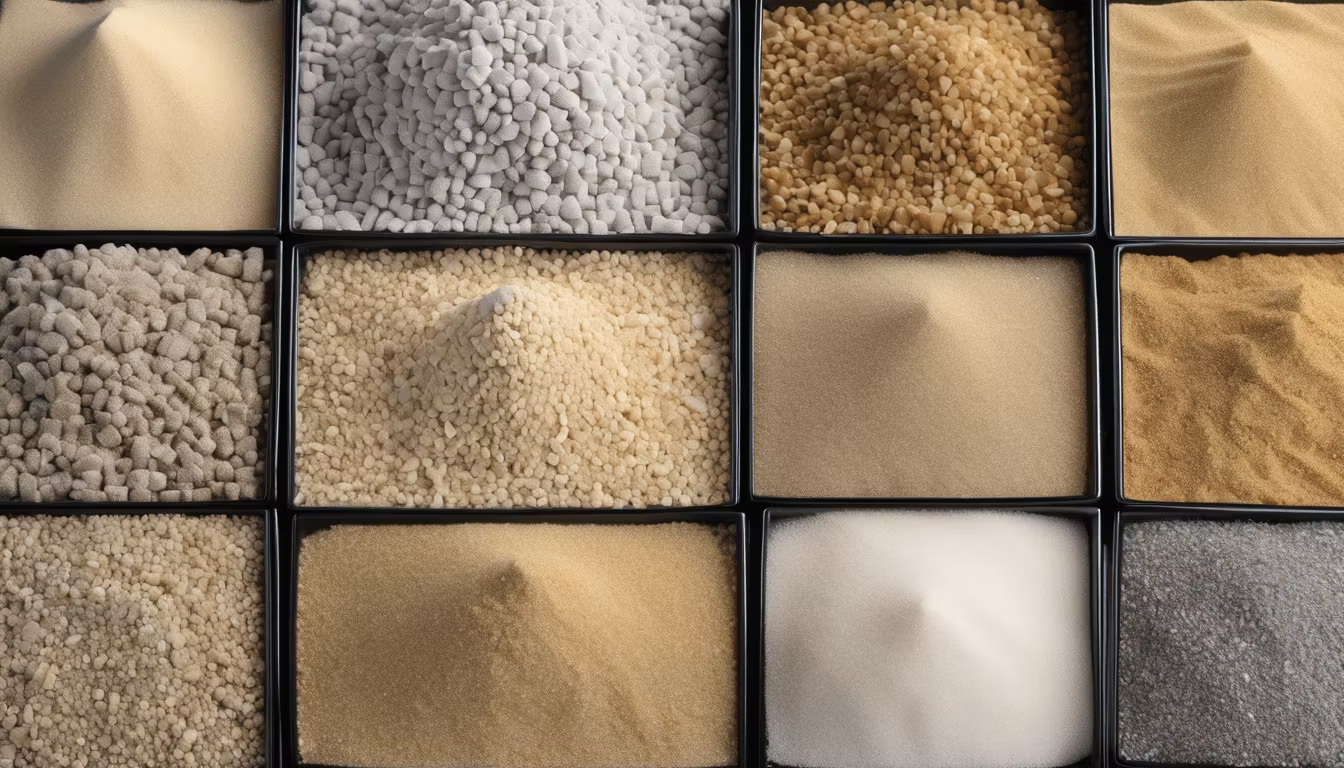
Mesh grade refers to the number of openings per linear inch in a sieve screen used to measure particle size. A higher mesh number indicates smaller particles, while lower mesh numbers represent coarser sand. This standardized measurement system, governed by ASTM D1921 standards, ensures consistency and comparability across suppliers and applications.
The relationship between mesh grade and actual particle size is inverse and logarithmic. For example, 100-mesh sand passes through a sieve with 100 openings per inch, resulting in particles approximately 150 micrometers in diameter. Understanding this relationship is essential for procurement managers and operations specialists selecting materials for specific industrial processes.
Sand grading directly affects flowability, packing density, surface area, and material performance in downstream applications. Incorrect mesh selection can result in product defects, reduced efficiency, increased waste, and higher production costs.
How Particle Size Impacts Industrial Performance
Finer mesh grades (higher numbers) increase surface area, which enhances chemical reactivity and binding efficiency in applications like glass manufacturing and refractory production. Coarser grades provide better drainage and flowability, making them ideal for filtration systems and foundry applications.
The optimal mesh grade balances multiple factors: material flow characteristics, packing efficiency, chemical reactivity requirements, and downstream processing capabilities. Industrial buyers must evaluate these variables against their specific operational constraints and quality specifications.
Common Silica Sand Mesh Grades and Their Applications
Coarse Grades: 8-40 Mesh
Particle Size Range: 2,000-500 micrometers
Coarse mesh silica sand serves applications requiring rapid drainage and excellent flowability. The larger particle size creates voids that facilitate water percolation and air circulation, making these grades essential for:
- Water Treatment Filtration: Rapid sand filters and multi-stage treatment systems rely on coarse silica to manage high flow rates while maintaining clarification efficiency
- Foundry Mold Making: Coarse grades provide structural integrity and gas permeability in green sand molding processes
- Concrete and Mortar Production: Larger particles create stronger mechanical interlocking within cementitious matrices
- Landscaping and Construction: Aesthetic applications and base course preparation benefit from consistent coarse grading
Medium Grades: 60-100 Mesh
Particle Size Range: 250-150 micrometers
Medium mesh silica sand represents the industry workhorse, balancing particle size benefits with practical handling characteristics. This range dominates industrial procurement due to versatility across multiple sectors:
- Float Glass Manufacturing: Consistent particle size ensures homogeneous melting and optical clarity in glass production
- Ceramic and Tile Production: Medium grades provide optimal packing density and reduce porosity in fired products
- Industrial Coatings: Anti-slip surfaces and functional coatings rely on consistent medium-grade silica for predictable performance
- Blast Media and Abrasives: Controlled particle size maintains cutting efficiency while minimizing substrate damage
Fine Grades: 120-200 Mesh
Particle Size Range: 125-75 micrometers
Fine mesh silica sand maximizes surface area and chemical reactivity, making it indispensable for precision applications demanding superior material properties:
- Specialty Glass Production: Solar panel glass, optical glass, and container glass manufacturing require fine, uniform particles for optimal transparency and strength
- Advanced Ceramics: Electronic ceramics, technical tiles, and high-performance refractories demand fine grading for dimensional accuracy
- Paint and Coating Additives: Fine silica improves surface finish, durability, and anti-slip characteristics in industrial coatings
- Chemical and Pharmaceutical Processing: High surface area supports filtration, separation, and chemical reaction optimization
Mesh Grade Selection Criteria for Industrial Buyers
Application-Specific Requirements
Begin by documenting precise application requirements. Critical parameters include:
- Particle Size Specification: Verify exact micron ranges or mesh numbers required by your production process
- Purity and Contamination Limits: Iron oxide, clay, and other contaminants impact product performance; ensure supplier testing meets specifications
- Moisture Content: Affects flowability and downstream processing; typically specified below 0.5% for industrial-grade silica
- Bulk Density: Influences material handling equipment sizing and transport efficiency
- Shape and Roundness: Affects packing efficiency and flow characteristics in specific applications
Production Volume and Supply Chain Considerations
Match mesh grade selection with your production volume requirements and supply reliability needs. CV Indoalam Mineral Persada offers flexible supply arrangements from 100-metric-ton trial shipments to multi-million-ton annual contracts, enabling manufacturers to optimize inventory management and reduce working capital requirements.
Consistent supply of properly graded material prevents production disruptions and maintains quality standards. Direct sourcing from mining operations, as opposed to trading through multiple intermediaries, reduces lead times and ensures material traceability and batch consistency.
Cost-Performance Optimization
Finer mesh grades command premium pricing due to additional processing and classification costs. Evaluate whether specifications truly require fine grades, or if coarser alternatives might achieve performance objectives at reduced cost. Conversely, attempting to use oversized material in applications demanding fine particles often results in product defects and rework expenses exceeding material savings.
Total cost analysis should include material price, freight, handling equipment compatibility, processing efficiency, and finished product quality. A slightly higher material cost for properly graded silica often delivers superior economic performance through reduced waste and improved product consistency.
Quality Assurance and Testing Standards
Industry Testing and Certification
Reputable silica sand suppliers conduct independent laboratory testing to verify mesh grade compliance and material purity. CV Indoalam Mineral Persada maintains SUCOFINDO certification for all silica products, ensuring third-party verification of particle size distribution, SiO2 content at 99.74%, and contamination levels.
Certification documentation should accompany each shipment, providing certificates of analysis confirming mesh grade compliance, moisture content, and bulk density. This documentation supports your quality management systems and provides traceability for regulatory compliance.
Particle Size Distribution Analysis
Beyond nominal mesh grade, evaluate the complete particle size distribution (PSD). Some suppliers sell material nominally classified as 100-mesh but with significant quantities passing 200-mesh or retained on 80-mesh. This variation dramatically impacts application performance.
Request particle size distribution curves showing percentage retained on sequential mesh sizes. Narrow, well-defined distributions indicate superior processing controls and more predictable application performance compared to broad distributions representing mixed or unclassified materials.
Optimizing Procurement Strategy
Direct Sourcing Advantages
Sourcing directly from mining operations rather than through multiple trading intermediaries offers significant advantages for industrial buyers. Direct relationships ensure material traceability, enable customized mesh grading, support flexible supply arrangements, and often reduce per-unit costs through elimination of middleman markups.
Established mining companies with IUP OPK licenses and RKAB approval provide documented compliance with Indonesian mining regulations and environmental standards. This reduces procurement risk and ensures consistent, reliable supply of legally sourced material.
Sampling and Qualification Procedures
Before committing to large-volume supply agreements, request representative samples for in-house testing and trial production runs. Standard practice involves 100-500 kilogram samples allowing thorough evaluation of material characteristics, processing compatibility, and finished product performance.
Document findings from trial runs systematically, comparing material performance against existing supplier baselines and specification requirements. This empirical approach reduces substitution risk and supports informed supplier selection decisions.
Flexible Supply Arrangements
Modern B2B mineral suppliers recognize that buyers face varying supply requirements depending on production schedules, inventory levels, and project-specific demands. Suppliers offering flexible contracting arrangements—from spot purchases to long-term supply agreements—provide operational flexibility supporting business optimization.
Lock in supply security through term agreements while maintaining flexibility to adjust monthly volumes within agreed ranges. This approach balances inventory efficiency with supply reliability.
Beyond Silica Sand: Integrated Mineral Solutions
While silica sand represents a critical industrial material, many manufacturers require additional minerals and materials. Consider partnering with suppliers offering complementary product portfolios. For example, specialized foundries might require both silica sand for mold making and zircon sand for specialized applications, simplifying procurement and logistics through single-supplier relationships.
CV Indoalam Mineral Persada supplies a comprehensive range of industrial minerals including aluminium ingots for casting applications, zircon sand for advanced ceramics and foundry coatings, and nickel ore for domestic smelter supply—enabling integrated sourcing that reduces administrative overhead while improving supply chain resilience.
Conclusion: Making Informed Mesh Grade Decisions
Selecting appropriate silica sand mesh grades requires balancing application-specific technical requirements against cost considerations, supply reliability, and quality assurance standards. Understanding how particle size influences material performance enables procurement professionals to optimize industrial operations and maintain competitive manufacturing costs.
Partner with established mineral suppliers offering:
- Direct mining sourcing with transparent material traceability
- Independent laboratory testing (SUCOFINDO certification)
- Multiple mesh grades (8-200) supporting diverse applications
- Flexible supply arrangements from trial quantities to multi-million-ton annual volumes
- Regulatory compliance (IUP OPK, RKAB, ET Batubara licenses)
CV Indoalam Mineral Persada has established itself as a trusted B2B supplier for Indonesian manufacturers requiring premium-quality silica sand with assured mesh grading, purity specifications, and reliable supply. Our direct mining operations, combined with rigorous quality testing and flexible supply arrangements, ensure your operations maintain optimal performance and competitive cost structures.
Contact us today to discuss your specific mesh grade requirements, request sample shipments, or establish a long-term supply agreement with a supplier committed to material excellence and partnership success.