Silica Sand Drying & Classification: Complete Industrial Processing Guide

Silica Sand Drying and Classification: Complete Industrial Processing Guide
Silica sand processing doesn't end at extraction. The journey from raw ore to market-ready product involves critical drying and classification stages that directly impact quality, usability, and profitability. Whether you're sourcing silica sand for glass manufacturing, ceramics production, or foundry applications, understanding these processing methods is essential for making informed procurement decisions.
CV Indoalam Mineral Persada supplies premium silica sand with SiO₂ content of 99.74% across multiple mesh grades (8-200), all processed through rigorous drying and classification protocols. This guide explores the industrial processes that ensure consistency, purity, and performance in your operations.
Why Silica Sand Drying Matters in Industrial Applications
Raw silica sand from mining operations contains significant moisture content—typically 8-15% by weight. This moisture creates multiple operational challenges:
Quality Degradation: Moisture promotes agglomeration and caking, making the material difficult to handle and reducing flow properties essential for foundries and glass manufacturers. Moisture also accelerates oxidation of trace elements, potentially introducing unwanted impurities.
Processing Inefficiencies: Wet sand requires additional handling equipment and increases transportation weight, raising logistics costs. In casting operations, moisture can cause defects through steam generation during molten metal contact.
Storage Problems: Damp sand deteriorates during storage, developing clumping and bacterial growth that compromises long-term viability. For facilities with limited storage space, the bulk density of wet sand becomes a significant constraint.
Industrial-grade silica sand drying reduces moisture to 0.5% or less, ensuring optimal material properties and extended shelf life. This investment in proper drying translates directly to reduced waste, improved product consistency, and enhanced operational efficiency across your production lines.
Rotary Dryer Technology for Silica Sand Processing
How Rotary Dryers Operate
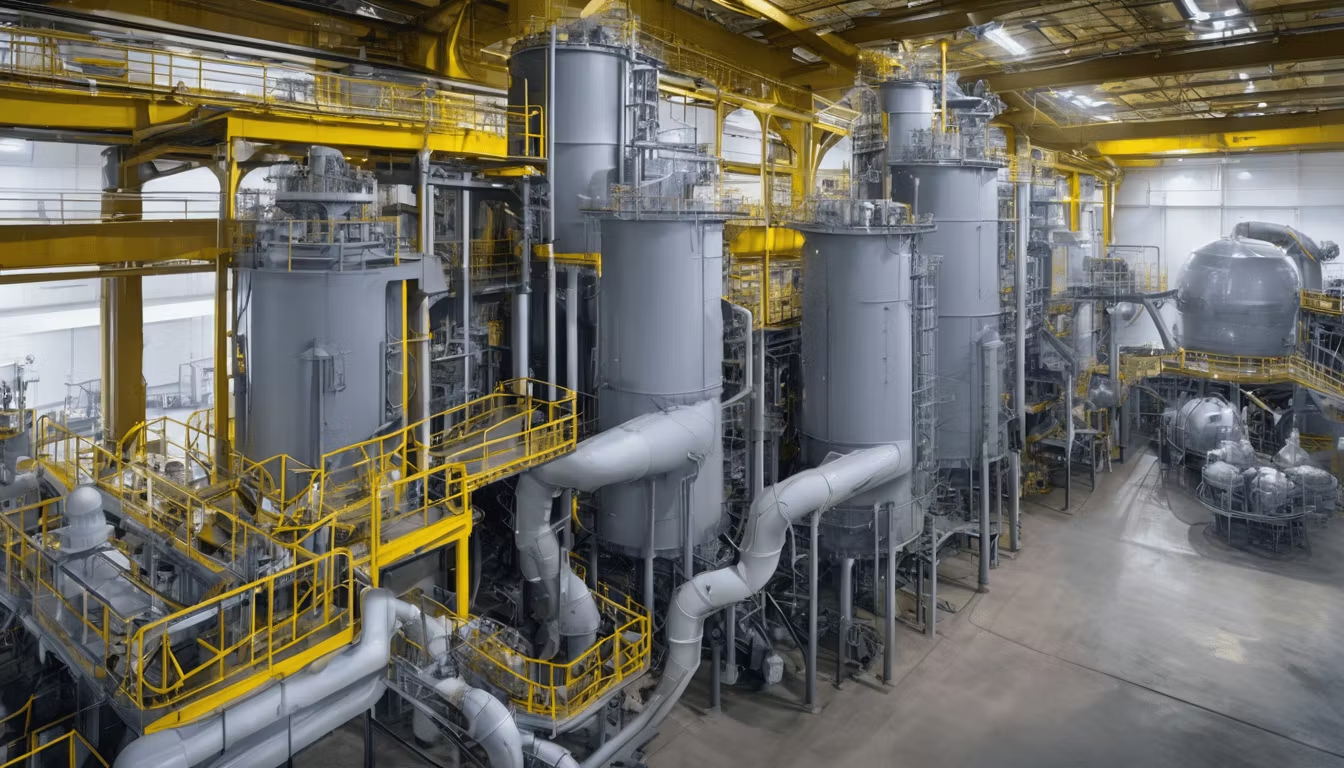
Rotary dryers represent the industry standard for large-scale silica sand drying. These cylindrical vessels, typically 2-4 meters in diameter and 10-15 meters in length, rotate on horizontal axes at 4-8 RPM. Material continuously cascades through a heated internal environment as the drum rotates.
The process works through direct heat transfer: Hot air (typically 300-400°C) circulates through the rotating drum while sand tumbles continuously. This dual-action—mechanical movement combined with thermal energy—ensures uniform moisture removal without material degradation.
Key Parameters Affecting Drying Efficiency
Temperature Control: Optimal inlet temperatures range from 300-350°C for silica sand. Excessive heat (above 400°C) can cause thermal stress and create fine dust, reducing product quality. Temperature monitoring throughout the drum ensures consistent drying rates.
Residence Time: Sand typically requires 15-30 minutes inside the rotary dryer, depending on initial moisture content and target specifications. Longer residence times ensure complete moisture removal but increase energy consumption. Modern systems balance these factors through variable speed control.
Airflow Management: Concurrent flow (air and material moving in same direction) offers faster drying but risks material damage. Counter-current systems (opposite direction flow) provide gentler processing, essential for maintaining sand grain integrity required in precision casting and glass applications.
Fuel Efficiency: Natural gas, coal, or biomass can fuel rotary dryers. Fuel choice impacts operational costs and environmental compliance. Modern facilities increasingly adopt waste heat recovery systems, capturing exhaust energy to preheat incoming material—reducing fuel consumption by 15-25%.
Advanced Features in Modern Rotary Dryers
Contemporary rotary dryer systems include sophisticated monitoring and control mechanisms. Real-time moisture sensors track drying progress, automatically adjusting drum speed and air temperature. Some installations feature internal lifting flights that optimize material tumbling and heat transfer efficiency.
Dust collection systems integrated with rotary dryers capture fine particles generated during processing. Multi-stage cyclones and baghouse filters recover valuable silica fines while meeting environmental standards. For facilities producing multiple mesh grades, this dust recovery becomes economically significant.
Sand Classification Systems: Achieving Precise Mesh Grades
Understanding Air Classification Technology
Air classification separates silica sand into specific size ranges through controlled airflow and gravitational principles. Unlike mechanical sieving, which uses vibrating screens, air classifiers sort material based on particle settling velocities—a more efficient method for handling large volumes while minimizing dust generation.
The air classifier silica process begins when dried material enters the classifier chamber. Upward-moving air creates a stratified separation: heavier, larger particles settle downward (coarser fraction), while lighter, smaller particles remain suspended and exit via the top stream (finer fraction). By adjusting air velocity precisely, operators achieve consistent mesh cuts across production runs.
Types of Air Classification Systems
Vertical Spiral Classifiers: Traditional design featuring a rotating spiral that moves material upward against settling gravitational force. Water-based medium provides better separation control but requires additional dewatering. Less common for sand classification due to moisture reintroduction.
Horizontal Air Classifiers: Modern dry classification solution where material travels horizontally through a chamber with precise vertical airflow. Superior for high-throughput operations and maintains product dryness. Ideal for producing multiple mesh grades (8-200) from single input stream.
Dynamic Classifiers: Advanced systems with rotating wheels or discs that impart centrifugal force, enhancing separation efficiency. Particularly effective for separating fine particles and achieving narrow size distributions—critical for precision glass manufacturing and high-performance ceramics.
Key Classification Metrics
Cut Point (d50): The particle size where 50% passes and 50% is retained. Controlling cut points determines mesh grade consistency. For example, 100 mesh sand has d50 around 150 micrometers. Precision in cut point directly affects product uniformity and customer satisfaction.
Sharpness Index: Measures how effectively the classifier separates size fractions. Higher sharpness (steeper separation curve) means less overlap between size grades. Industrial-grade classifiers achieve sharpness indices of 0.7-0.9, ensuring minimal crossover between adjacent size grades.
Throughput Capacity: Modern air classifiers handle 50-500 metric tons per hour, depending on material density and target mesh fineness. Indoalam's processing facilities support annual capacity of 2.5 million metric tons, enabling consistent supply for large-scale industrial operations.
Integration of Drying and Classification in Processing Plants
Process Flow Optimization
Efficient silica sand plants sequence drying before classification. This approach prevents moisture from interfering with size separation—wet particles stick together and resist proper classification. The optimal sequence involves:
Step 1—Raw Material Reception: Extracted sand undergoes initial screening to remove oversized material and debris. This protects downstream equipment and improves drying uniformity.
Step 2—Rotary Drying: Material passes through heated rotary dryers, reducing moisture to specification levels (typically 0.3-0.8% for industrial applications).
Step 3—Air Classification: Dried sand enters air classifiers where it's separated into precise mesh grades based on customer requirements.
Step 4—Quality Testing: Processed material undergoes laboratory analysis for SiO₂ content, moisture, grain size distribution, and trace elements. SUCOFINDO testing ensures compliance with international standards.
Step 5—Packaging and Shipment: Classified sand is packaged in bulk bags or containerized for delivery to end-users across Indonesia and international markets.
Quality Control Throughout Processing
Multiple quality checkpoints ensure consistency at each stage. Moisture analyzers monitor dryer output. Laser diffraction particle size analyzers verify classification accuracy. Chemical analysis confirms SiO₂ purity and identifies trace contaminants.
This systematic approach—combined with IUP OPK licensing and RKAB approval—guarantees that finished product meets specifications for diverse applications: float glass production (requiring 99.7%+ SiO₂), ceramic glazes, foundry molds, and water filtration systems.
Industrial Applications Requiring Processed Silica Sand
Glass Manufacturing
Float glass production demands ultra-pure silica sand with SiO₂ ≥99.7% and minimal iron oxide (<0.1%). The drying process is critical—moisture introduces quality defects and reduces furnace efficiency. Properly dried and classified sand ensures clear, defect-free glass production at scale.
Foundry Operations
Casting facilities require precisely graded silica sand (typically 50-100 mesh) with controlled moisture (0.5-2%). Proper drying prevents steam-related casting defects. AFS grain fineness number specifications demand consistent classification achieved only through professional air classification systems.
Ceramics and Tile Production
Ceramic body formulations require multiple silica sand fractions combined in specific ratios. Classification into narrow mesh ranges (like 100-150 mesh) enables ceramic manufacturers to achieve desired green strength and firing characteristics. Moisture control prevents premature binding and ensures consistent batch properties.
Water Treatment Systems
Sand filtration uses specific mesh grades (typically 12-40 mesh) to remove suspended solids and particulates. Proper drying and classification ensure predictable filtration rates and extended filter life, making this application critical for municipal water treatment and industrial wastewater handling.
Sourcing High-Quality Processed Silica Sand: What to Evaluate
Supplier Capabilities
When selecting a silica sand supplier, evaluate their processing infrastructure. Reputable suppliers invest in modern rotary dryers with precise temperature control and advanced air classification systems. Ask about equipment specifications, maintenance schedules, and quality control protocols.
Verify licensing credentials. Legitimate suppliers maintain IUP OPK permits covering mineral logam and non-logam operations, along with SUCOFINDO testing certifications. These credentials ensure compliance with Indonesian mining regulations and international quality standards.
Quality Documentation and Testing
Request complete certification for chemical composition (SiO₂ content, Fe₂O₃, Al₂O₃, trace elements), physical properties (moisture, grain size distribution, bulk density), and compliance documentation. Independent laboratory testing provides confidence in material specifications.
Suppliers should offer flexibility in mesh grade production. Whether you need single-grade bulk shipments or multiple size fractions for custom formulations, experienced processors accommodate diverse requirements without minimum order barriers.
Supply Reliability and Logistics
Production capacity directly impacts supply consistency. Facilities processing 2.5 million metric tons annually can reliably serve both large industrial accounts and emerging market segments. Understanding sourcing regions (Sulawesi, Kalimantan, Maluku offer excellent silica reserves) helps assess supply security.
Evaluate logistics capabilities. Quality processors offer containerized exports for international shipments and bulk delivery systems for domestic customers. This flexibility becomes essential when managing supply chains across multiple production facilities.
Cost Considerations in Silica Sand Drying and Classification
Processing costs represent significant portions of final silica sand prices. Fuel expenses for rotary drying typically account for 30-40% of processing costs. Energy-efficient systems with heat recovery reduce operational expenses while minimizing environmental impact.
Classification equipment represents capital investment but improves profitability through reduced waste and premium pricing for precisely graded products. High-sharpness classification systems justify their cost through consistency that reduces customer rejections and rework.
Buying direct from mining operators with integrated processing eliminates middleman markups. Indoalam's direct-from-mine model, combined with advanced processing capabilities, delivers competitive pricing without compromising quality.
Environmental and Safety Considerations
Modern silica sand processing balances efficiency with environmental responsibility. Dust collection systems capture fine particles, preventing air quality degradation. Baghouse filters and cyclone separators recover valuable material while protecting worker health.
Occupational exposure to silica dust requires strict controls. Professional operations provide respiratory protection, maintain air quality monitoring, and follow respirable crystalline silica standards. Facilities with proper ventilation and engineering controls ensure worker safety while maintaining productivity.
Water management in classification systems—particularly for wet separation processes—requires treatment before discharge. Modern facilities implement settling ponds and water recycling systems, minimizing environmental footprint.
Future Trends in Silica Sand Processing
Automation increasingly shapes industrial processing. AI-powered quality control systems monitor drying parameters in real-time, optimizing energy consumption and product consistency. Automated classification systems with dynamic adjustment ensure precise mesh cuts across extended production runs.
Sustainability drives innovation. Waste heat recovery systems, electrical dryers replacing fuel-based models, and zero-discharge classification systems represent growing trends. These technologies reduce operational costs while meeting stricter environmental regulations.
Market demand for ultra-fine silica (200+ mesh) continues expanding, particularly for advanced ceramics, pharmaceuticals, and high-tech applications. Processing facilities investing in dynamic classification systems position themselves for these premium market segments.
Conclusion: Partnering with Experienced Silica Sand Processors
Silica sand drying and classification represent essential steps transforming raw mineral into market-ready product meeting exacting industrial specifications. Understanding these processes—rotary dryer technology, air classifier operations, and integrated quality control—enables informed supplier selection and optimal material sourcing decisions.
CV Indoalam Mineral Persada brings comprehensive processing expertise to silica sand supply. Operating from premium sourcing regions including Sulawesi, Kalimantan, and Maluku, we process material through advanced drying and classification systems, delivering 99.74% pure silica sand across mesh grades 8-200. Our IUP OPK licensing, SUCOFINDO testing, and RKAB approval ensure compliance with all regulatory requirements while maintaining industrial-grade quality standards.
Whether you're sourcing material for glass manufacturing, foundry operations, ceramics production, or water treatment systems, our flexible supply model accommodates trial quantities (100 MT) through large-scale contracts (2.5M MT/year). Direct sourcing from our mining operations eliminates intermediary costs while ensuring supply reliability and product consistency.
Contact us to discuss your silica sand requirements. Our technical team provides detailed specifications, samples, and pricing for your specific application. Let Indoalam become your trusted partner in premium silica sand supply.