Silica Sand Mesh Grades: Complete Guide to Particle Size Selection

Understanding Silica Sand Mesh Grades: A Complete Industrial Guide
Silica sand is one of the most versatile industrial minerals, but selecting the correct mesh grade can make or break your manufacturing process. Whether you're a glass manufacturer, foundry operator, or ceramics producer, understanding silica sand mesh grades and particle size distribution is essential for achieving optimal product quality and operational efficiency.
In this comprehensive guide, we'll explore everything you need to know about silica sand mesh grades, from particle size standards to practical application recommendations. As a leading Indonesian mineral supplier with direct access to premium silica sand deposits, we've helped hundreds of B2B customers find the perfect mesh grade for their specific needs.
What Are Mesh Grades and Why Do They Matter?
The Basics of Mesh Grading
Mesh grades refer to the standardized particle size classification system used in the mineral industry. The "mesh" number indicates how many openings per linear inch exist in a screen or sieve used to separate particles. A higher mesh number means smaller particles, while a lower mesh number indicates coarser material.
For example, 100-mesh silica sand will pass through a screen with 100 openings per inch, while particles retained on a 100-mesh screen are larger. This standardized classification system—primarily based on the Tyler and ASTM standards—ensures consistency and predictability across global supply chains.
Why Particle Size Matters in Industrial Applications
Particle size distribution directly affects:
- Surface area exposure: Finer particles provide greater surface area for chemical reactions
- Packing density: Different mesh grades compact differently, affecting material density
- Permeability: Coarser grades allow better fluid flow; finer grades offer better filtration
- Product appearance: Finish quality and texture depend on sand particle uniformity
- Processing efficiency: Right-sized particles reduce processing time and waste
Common Silica Sand Mesh Grades and Their Applications
8-16 Mesh (Coarse Grade)
With particle sizes ranging from 2.38mm to 0.595mm, 8-16 mesh silica sand is the coarsest commonly available grade. This grade is typically used in applications requiring:
- Foundry molds and cores where high permeability is essential
- Water treatment and filtration systems requiring rapid flow rates
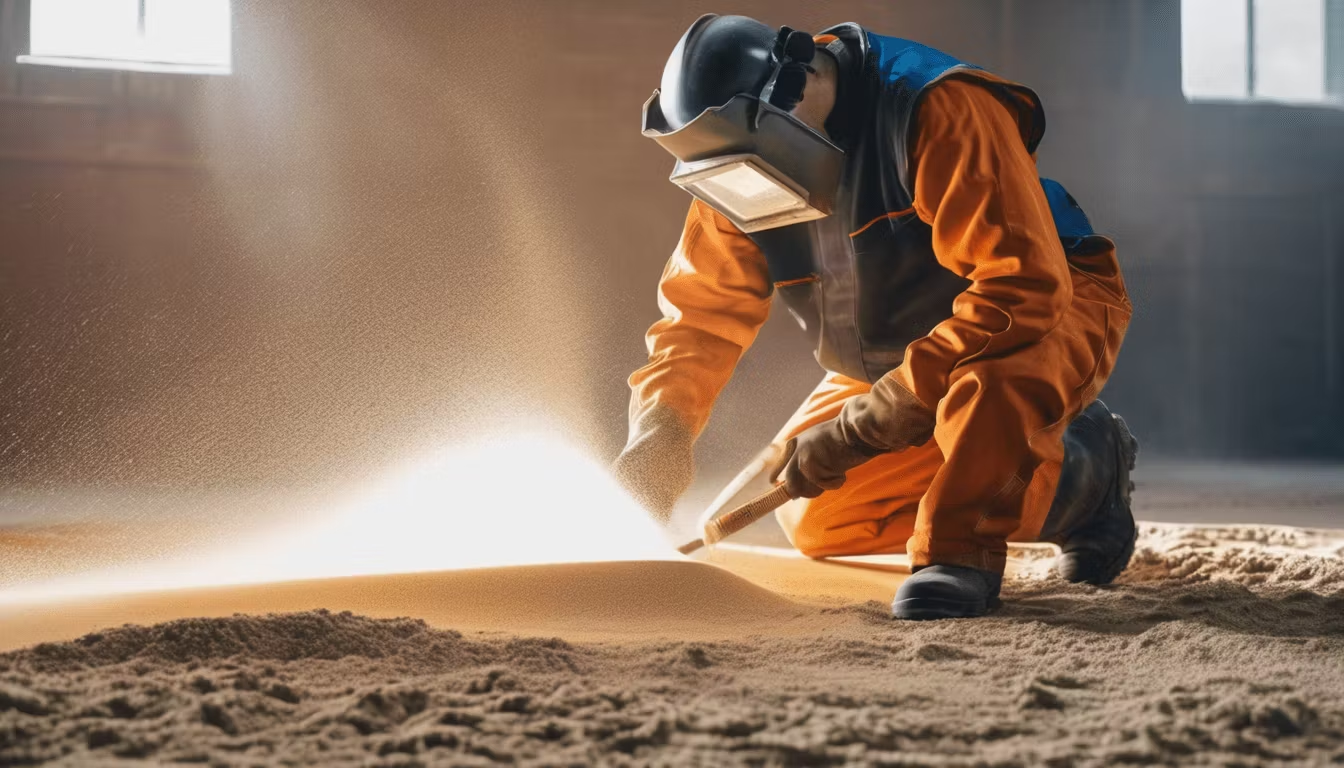
- Sandblasting operations where abrasive power matters more than finish quality
- Heavy construction and concrete aggregate applications
The large particle size creates significant void space between grains, making this grade ideal when drainage and permeability are critical factors.
20-40 Mesh (Medium-Coarse Grade)
This versatile grade (particle size 0.841mm to 0.297mm) represents a sweet spot for many industrial applications. Commonly used for:
- Glassmaking in float glass and container glass production
- Ceramic and tile manufacturing requiring balanced particle distribution
- Refractory material production
- Golf course and sports field construction
- Blast media for moderate abrasive applications
The 20-40 mesh grade offers excellent balance between permeability and surface area, making it suitable for both precision and high-volume applications.
60-100 Mesh (Fine Grade)
With particles ranging from 0.297mm to 0.149mm, 60-100 mesh silica sand serves applications demanding finer detail and greater surface area. Industries using this grade include:
- High-precision glass manufacturing for optical applications
- Fine ceramics and porcelain production
- Foundry work requiring superior casting surface finish
- Water filtration where fine particle trapping is necessary
- Specialized coating applications
150-200 Mesh (Extra Fine Grade)
At 0.149mm to 0.074mm particle size, this ultra-fine grade is reserved for specialized applications requiring exceptional precision:
- Solar panel glass manufacturing
- High-end optical glass production
- Precision electronic component manufacturing
- Fine abrasive compounds and polishing media
- Advanced filtration and purification systems
The extremely fine particle size creates maximum surface area and uniform distribution, essential for premium-grade products.
Understanding Silica Sand Specifications Beyond Mesh Grade
SiO2 Purity and Quality
While mesh grade indicates particle size, the chemical composition determines quality. Our quartz sand maintains SiO2 purity of 99.74%, meeting strict international standards. Higher purity means:
- Better performance in glass manufacturing without color contamination
- Superior quality in ceramic and tile production
- Improved filtration efficiency in water treatment
- Reduced impurities affecting final product specifications
SUCOFINDO laboratory testing certifies our material specifications, ensuring consistent quality across every shipment.
Particle Size Distribution (PSD)
Beyond single mesh grades, particle size distribution describes the percentage of material within specific size ranges. For example, a "medium sand" might contain 70% material between 60-200 mesh with 30% between 20-60 mesh. This distribution profile significantly impacts application suitability.
Bulk Density and Moisture Content
Different mesh grades compact with varying density. Coarser materials (8-16 mesh) typically achieve 1.55-1.60 g/cm³ bulk density, while finer grades (150-200 mesh) may reach 1.70-1.75 g/cm³. Moisture content affects handling and processing efficiency, making it critical for quality control.
How to Select the Right Mesh Grade for Your Application
Step 1: Define Your Process Requirements
Begin by identifying what your process actually needs. Ask yourself:
- What is the primary function? (filtering, aggregate, mold-making, coating)
- What flow rates or permeability are required?
- What surface finish or appearance standards must be met?
- What chemical compatibility is necessary?
Step 2: Consider Particle Size Distribution
Single-grade mesh is rarely optimal. Most industrial applications benefit from a tailored blend of two or three mesh grades. For instance, glass manufacturers often use 20-40 mesh as a base with 5-10% 8-16 mesh for bulk and 5-10% 60-100 mesh for fines.
Step 3: Evaluate Purity and Contamination Risks
Higher purity silica sand prevents contamination of final products. Industries like glass manufacturing have zero tolerance for iron oxide and other impurities, while water treatment applications can typically accept slightly lower purity grades.
Step 4: Test with Trial Quantities
Before committing to large-volume contracts, conduct pilot tests. Most professional suppliers, including Indoalam Mineral Persada, offer flexible minimum orders starting from just 100 metric tons, allowing you to validate mesh grade performance before scaling up.
Industry-Specific Mesh Grade Recommendations
Glass Manufacturing
Float glass producers typically specify 20-40 mesh as primary material with 10-15% fines (60-100 mesh) for complete melting. Optical and specialty glass demands 60-100 mesh or finer with exceptional purity. The uniformity ensures consistent glass quality and reduces energy consumption during melting.
Foundry and Metal Casting
Foundries require high-permeability cores and molds, making 8-16 or 16-30 mesh essential. The coarse particles allow gas escape during casting, preventing defects. However, the surface layer often uses 60-100 mesh to achieve better surface finish on final castings.
Ceramic and Tile Production
Ceramic body formulations typically blend 20-40 mesh as structural material with 60-100 mesh for surface smoothness. The specific blend depends on desired porosity and finished product characteristics.
Water Treatment and Filtration
Multi-layer filtration systems use coarse material (8-20 mesh) for initial contamination removal, medium grades (30-60 mesh) for secondary filtration, and fine material (100-200 mesh) for polishing. This graduated approach maximizes filter lifespan while improving water quality.
Sourcing Premium Silica Sand: What to Look For in Suppliers
Verification and Certification
Reputable suppliers maintain IUP OPK licenses and RKAB approval, ensuring legal operation and environmental compliance. SUCOFINDO testing certificates provide independent verification of specifications. Request recent test reports before committing to purchases.
Direct-Source Supply Advantage
Working with suppliers who source directly from mines eliminates middlemen, reduces costs, and improves consistency. Direct-source operations maintain greater control over quality, have better inventory availability, and can offer more flexible terms for large contracts.
Flexible Minimum Orders
Professional B2B suppliers should accommodate both trial shipments and long-term contracts. The ability to order 100 metric tons for testing or 2.5 million metric tons annually ensures scalability as your business grows.
Mesh Grade Blending and Custom Specifications
Why Single Grades Rarely Suffice
While standardized mesh grades provide consistency, many industrial processes benefit from customized particle size distributions. Glass manufacturers might request 70% 20-40 mesh, 15% 8-16 mesh, and 15% 60-100 mesh blended to specification. Ceramic producers might need entirely different ratios.
Cost-Performance Optimization
Strategic blending achieves optimal performance while controlling costs. Finer grades command premium pricing; blending small quantities with coarser, less-expensive material reduces overall cost without sacrificing critical performance characteristics.
Complementary Mineral Products for Your Operations
Beyond silica sand, integrated mineral suppliers offer related products addressing broader industrial needs. For metal casting operations requiring molding materials, zircon sand provides superior refractory properties with ZrO2 content of 65%+, handling extreme temperatures that silica sand cannot withstand.
For manufacturers requiring metal inputs, aluminium ingot in ADC12 and A7 grades serves foundries and metal processors needing consistent alloy feedstock. These complementary products from single suppliers simplify procurement and logistics.
Common Mistakes in Mesh Grade Selection
Over-Specifying Fine Grades
Selecting unnecessarily fine mesh grades inflates costs without performance benefit. Glass manufacturers sometimes over-specify, purchasing 150-200 mesh when 60-100 mesh performs adequately. Careful testing prevents expensive mistakes.
Ignoring Particle Size Distribution
Focusing only on "nominal" mesh grade while ignoring the distribution of fines and coarse materials creates inconsistency. Request detailed PSD analysis to understand actual material composition.
Neglecting Quality Verification
Price-based supplier selection without quality verification leads to repeated problems and production delays. Budget slightly more for certified, tested material from reliable suppliers to avoid costly disruptions.
Insufficient Inventory Management
Running out of specific mesh grades mid-production causes expensive shutdowns. Maintain reasonable safety stock, particularly for grades requiring longer supply lead times from remote regions.
The Role of Regional Sourcing in Quality and Cost
Indonesia's silica sand deposits in Sulawesi, Kalimantan, and Maluku regions offer exceptional quality and competitive pricing. Direct access to these deposits allows suppliers to maintain consistent specifications while keeping costs reasonable. Regional sourcing reduces shipping distances to major Asian manufacturing hubs, improving delivery speed and reducing logistics costs.
Future Trends in Silica Sand Applications
Industrial silica sand demand continues expanding, particularly in emerging applications:
- Solar Panel Manufacturing: Rapidly growing solar industry demands ultra-pure, fine-grade silica sand
- Advanced Filtration: Water scarcity drives development of sophisticated purification systems requiring premium-grade sand
- Green Building Materials: Sustainable construction incorporates recycled and responsibly-sourced silica sand
- Electronics Manufacturing: Precision applications require exceptional purity and particle uniformity
Getting Started: From Specification to Delivery
Beginning a relationship with a new silica sand supplier should be straightforward. Define your mesh grade requirements, request samples or trial quantities, verify specifications through independent testing, and establish flexible supply agreements that scale with your business.
CV Indoalam Mineral Persada specializes in this process, offering:
- All standard mesh grades (8-200) and custom blends
- SUCOFINDO-certified specifications and purity testing
- Trial quantities starting at 100 metric tons
- Flexible annual contracts up to 2.5 million metric tons
- Direct-source pricing and consistent quality
Conclusion: Making Informed Mesh Grade Decisions
Selecting the right silica sand mesh grade requires balancing particle size specifications, purity requirements, cost considerations, and application-specific performance needs. Understanding the relationship between mesh grades and industrial applications positions your company for operational efficiency and superior product quality.
Whether you need coarse 8-16 mesh for foundry cores, medium 20-40 mesh for glassmaking, or fine 150-200 mesh for solar panels, the mesh grade you select fundamentally impacts your manufacturing success. Invest time in proper specification, request quality verification, and contact us to discuss your silica sand requirements with mineral specialists who understand your industry's precise needs. With the right supplier partnership, you'll optimize both performance and profitability across your operations.