Indonesia's Top Mineral Exports: Nickel, Tin, Copper & Beyond
Indonesia's Dominance in Global Mineral Production
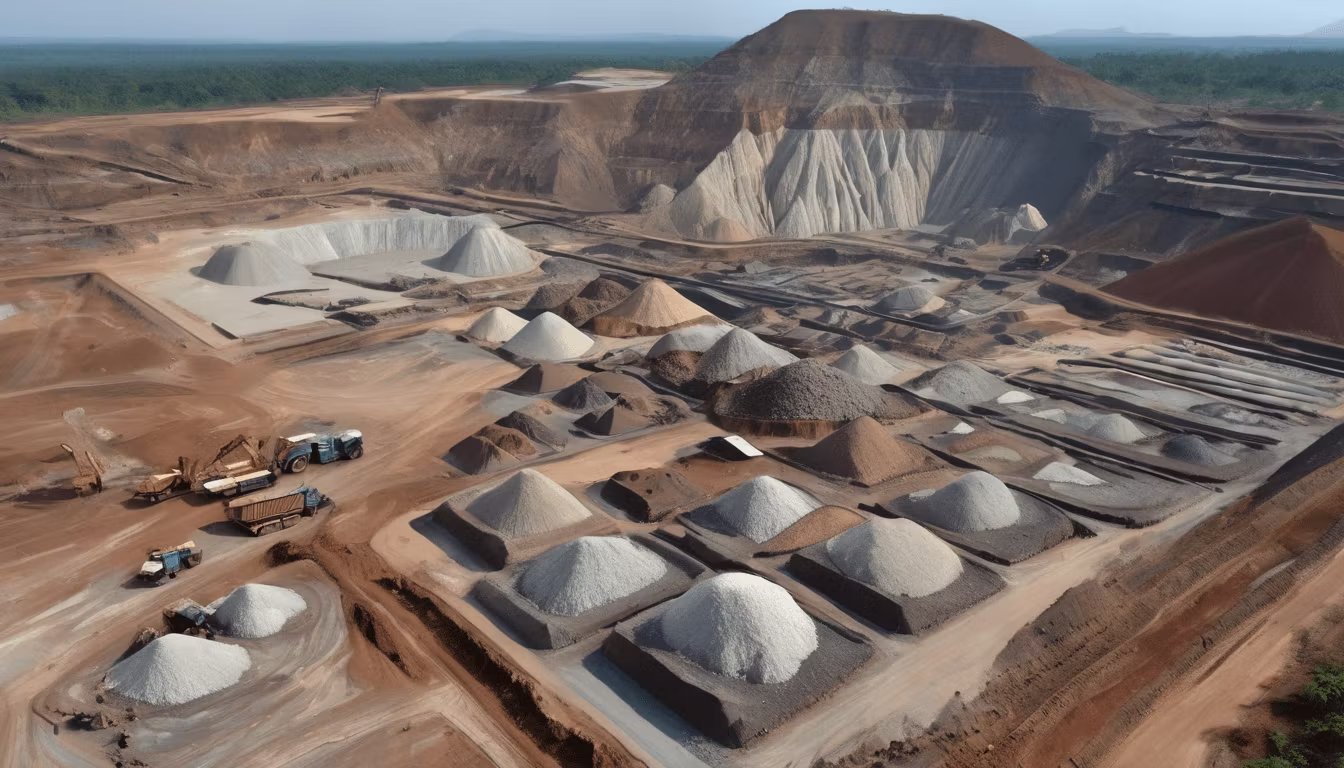
Indonesia stands as one of the world's most critical mineral suppliers, with vast reserves of strategic commodities essential to global manufacturing, energy, and construction industries. As Southeast Asia's leading mining nation, Indonesia's mineral production has shaped international supply chains for decades, particularly in the nickel, tin, copper, and industrial mineral sectors. The country's geographic position, coupled with extensive geological deposits, positions it as an indispensable player in the global commodity market.
For B2B buyers and industrial procurement managers, understanding Indonesia's mineral export landscape is crucial for sourcing decisions, supply chain planning, and market positioning. This comprehensive overview examines the top mineral exports from Indonesia, their applications, market dynamics, and the opportunities available for international traders and manufacturers.
Nickel: Indonesia's Mineral Export Crown Jewel
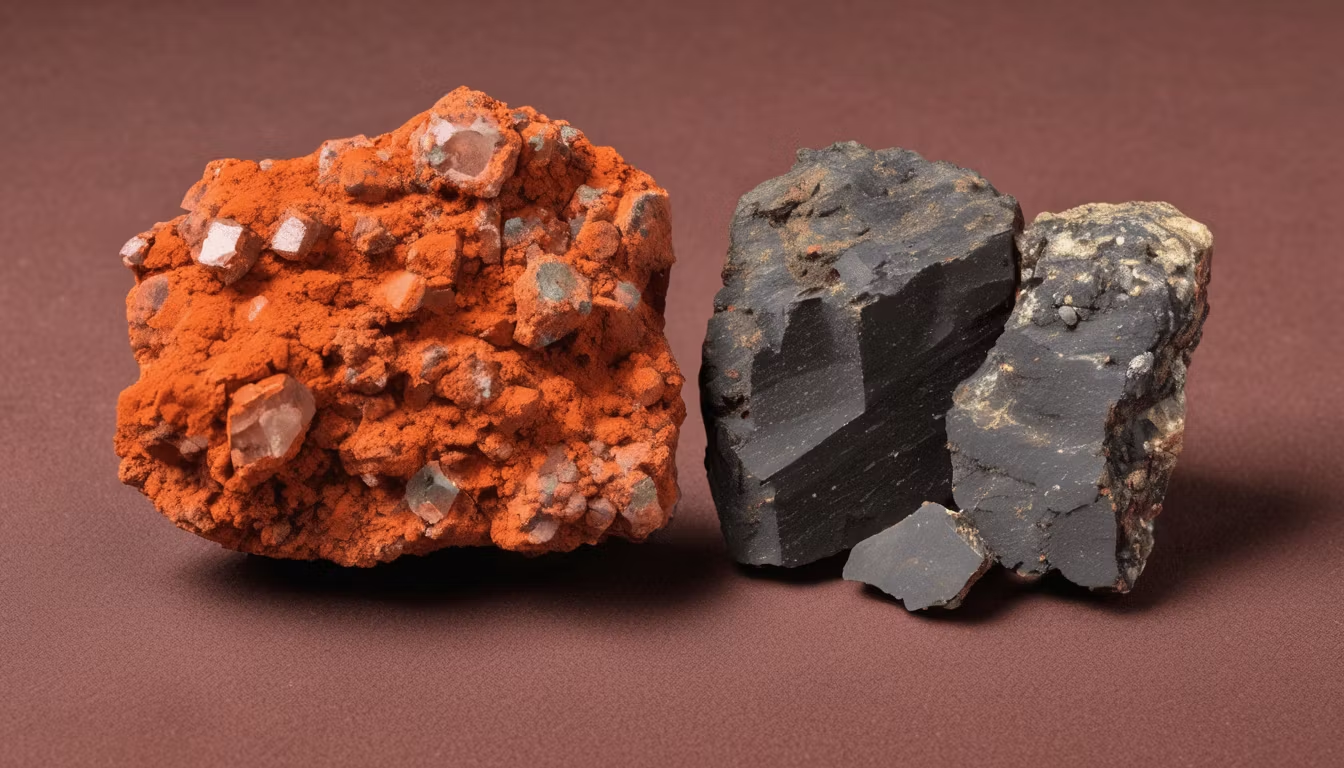
Nickel represents Indonesia's most significant mineral export by both volume and economic value. As the world's largest nickel producer, Indonesia controls approximately 30-40% of global nickel reserves, making it indispensable for battery manufacturing, stainless steel production, and aerospace applications. The country produces three primary categories of nickel ore: saprolite ore (typically 1.5-2.0% Ni content), limonite ore (0.8-1.2% Ni content), and laterite deposits suitable for both pyrometallurgical and hydrometallurgical processing.
Indonesia's nickel mining regions, concentrated in Sulawesi (particularly Morowali and Konawe), Kalimantan, and Maluku, have witnessed explosive growth in smelter capacity over the past decade. Major integrated nickel producers now operate direct reduction iron (DRI) facilities and high-pressure acid leach (HPAL) plants, transforming raw ore into refined nickel briquettes (NPI) and ferronickel products. This vertical integration has elevated Indonesia's role from mere ore exporter to value-added commodity supplier, capturing greater margins and serving premium industrial markets.
The nickel market dynamics are heavily influenced by electric vehicle (EV) battery demand, with lithium-ion battery cathodes requiring substantial nickel inputs. Battery-grade nickel commands premium pricing, incentivizing Indonesian producers to improve ore quality and processing standards. SUCOFINDO-certified testing ensures that nickel products meet international specifications required by smelters and downstream industries.
Silica Sand & Quartz: The Industrial Foundation
While less visually prominent than nickel, silica sand and quartz represent critical industrial minerals with diverse applications across multiple sectors. Indonesian silica sand deposits, sourced primarily from alluvial and marine environments across Sulawesi, Kalimantan, and Maluku, typically achieve 99.5%+ SiO₂ purity with minimal iron oxide contamination. These deposits come in multiple mesh grades (8, 16, 32, 60, 100, 150, 200), addressing specific end-use requirements from foundry operations to high-specification glass manufacturing.
The global silica sand market encompasses flooring, glass manufacturing, ceramics production, water filtration systems, and advanced industrial applications. Float glass production—the standard for automotive and architectural glazing—requires ultra-pure silica sand meeting strict specifications. Solar panel manufacturers also depend on consistent silica sand supplies for photovoltaic glass substrates. Indonesia's silica sand exports, with annual capacity reaching 2.5 million metric tons, supply glass manufacturers throughout Southeast Asia, India, and increasingly, Middle Eastern buyers seeking reliable alternative suppliers outside traditional sourcing regions.
Quality and consistency are paramount in silica sand procurement. Particle size distribution, silica purity, iron content, and moisture levels directly impact downstream production efficiency and product quality. Buyers prioritize suppliers offering SUCOFINDO laboratory testing, clear quality documentation, and consistent grading to minimize production interruptions.
Tin & Copper: Indonesia's Historic Mining Legacy
Tin mining in Indonesia dates back centuries, with the Bangka and Belitung islands establishing themselves as global tin production centers. Though tin production has declined from historical peaks, Indonesia remains a significant global supplier, with reserves concentrated in offshore and alluvial deposits. Tin's applications in solder, bronze alloys, plating, and electronic components ensure continued demand despite competing synthetic alternatives and recycled tin streams.
Copper mining, while smaller than nickel or tin in terms of Indonesian export volume, contributes meaningfully to mineral sector revenues. Indonesian copper deposits, often associated with gold mineralization in major porphyry systems, yield both primary and byproduct copper concentrates. These copper products supply smelters, refineries, and manufacturers of electrical components, automotive parts, and construction materials throughout Asia-Pacific markets.
The tin and copper markets face cyclical pressures tied to global manufacturing activity, construction cycles, and electronics demand. Indonesian producers have adapted by diversifying product portfolios and investing in processing technology to extract maximum value from complex mineral deposits containing multiple commodities.
Specialty Minerals: Zircon & Aluminium Ingots
Beyond major commodities, Indonesia supplies specialty minerals serving niche but valuable industrial applications. Zircon sand, containing 65%+ ZrO₂, finds applications in foundry mold-making, refractory production, and ceramic pigmentation. Zircon's thermal stability and hardness make it essential for precision casting operations in aerospace and automotive industries, where dimensional accuracy and surface finish are critical.
Aluminium ingot production, utilizing imported bauxite and recycled scrap, has expanded as Indonesian smelters capture downstream value. Automotive-grade aluminium (ADC12, A7) ingots serve die-casting operations producing engine blocks, transmission housings, and structural components. The growing automotive and consumer electronics manufacturing base across Indonesia and neighboring countries creates captive demand for consistent aluminium supply.
Specialty mineral procurement requires more rigorous supplier qualification, as end-users depend on consistent chemistry, particle morphology, and purity specifications. Suppliers like Indoalam differentiate themselves through SUCOFINDO certification, technical support, and flexible supply arrangements accommodating both trial lots (100+ metric tons) and large annual contracts.
Market Trends Shaping Indonesia's Mineral Exports
Several structural trends are reshaping Indonesia's mining sector and export dynamics:
Battery Supply Chain Integration
The global EV battery supply chain has become the primary driver of nickel demand growth. Indonesian nickel producers are increasingly integrating backward into battery precursor materials (NCA, NCM cathode precursors), positioning Indonesia as a battery supply hub rather than merely an ore exporter. This vertical integration captures greater margins and reduces price volatility exposure.
Environmental & Compliance Standards
International ESG commitments and carbon accounting requirements are pressuring Indonesian producers to adopt cleaner processing technologies, improve tailings management, and reduce carbon intensity. Buyers increasingly require suppliers with robust environmental permits (IUP OPK), approved environmental management plans (RKAB), and third-party audit certifications. This raises barriers to entry for marginal producers but rewards established, compliant operators.
Supply Chain Diversification
Geopolitical tensions and trade disputes have prompted global buyers to diversify sourcing away from concentrated suppliers. Indonesia, with its stable reserves and established mining infrastructure, benefits from this trend. Companies seeking alternative suppliers to traditional sources increasingly evaluate Indonesian producers for long-term partnerships and strategic supply security.
Processing & Beneficiation Investments
Rather than exporting raw ore, Indonesian companies are investing in processing capacity to produce higher-value products: smelted nickel, beneficiated silica sand, and specialty alloys. This value-addition strategy increases employment, captures greater export revenues, and reduces logistics costs for downstream buyers.
Quality Standards & Buyer Expectations
B2B mineral buyers evaluate Indonesian suppliers on several technical and operational criteria:
Laboratory Testing & Certification
SUCOFINDO, Indonesia's leading independent testing and certification provider, provides third-party assurance of mineral quality. Chemical analysis, particle size distribution, impurity levels, and moisture content must be documented and meet buyer specifications. Reputable suppliers provide complete test reports with every shipment, reducing dispute risk and enabling seamless supply chain integration.
Licensing & Regulatory Compliance
Legally operated mines hold IUP (Izin Usaha Pertambangan) and OPK (Operasi Produksi Komersial) permits confirming mineral rights and production authorization. RKAB (Rencana Kerja dan Anggaran Biaya) approval demonstrates adherence to environmental and operational plans. Buyers verify supplier compliance to mitigate regulatory and reputational risks associated with sourcing from unlicensed or non-compliant operations.
Contractual Terms & Supply Flexibility
Sophisticated buyers negotiate flexible supply agreements accommodating production fluctuations, quality variations, and market changes. Trial shipments (50-200 metric tons) allow production qualification without major commitments. Longer-term contracts (1-3 years) at index-linked pricing provide cost visibility while respecting market dynamics. Reliable suppliers offer both arrangements, demonstrating operational sophistication and customer focus.
Sourcing Opportunities with Indonesian Mineral Suppliers
For international buyers, manufacturers, and traders seeking Indonesian minerals, several strategic approaches optimize procurement:
Direct Mine Relationships: Establishing direct relationships with producers eliminates middlemen markups and provides supply chain visibility. Direct suppliers offering IUP/OPK licenses and SUCOFINDO testing provide transparency and risk mitigation advantages.
Quality Verification: Conducting on-site audits, reviewing test documentation, and requesting references from existing customers reduces quality surprises and supplier reliability risks. Established producers welcome verification visits, demonstrating operational confidence.
Flexible Contract Structures: Negotiating trial shipments before committing to long-term contracts allows production qualification and supply chain integration testing. Index-linked pricing formulas (tied to LME or other benchmark prices) balance cost predictability with market fairness for commodity minerals.
Why Choose Indoalam as Your Indonesian Mineral Partner
CV Indoalam Mineral Persada represents a new generation of Indonesian mineral suppliers combining comprehensive product portfolios, rigorous quality standards, and customer-focused operations. As a fully licensed IUP OPK operator with SUCOFINDO-tested products, Indoalam supplies nickel ore, silica sand, zircon, and aluminium ingots to smelters, glass manufacturers, foundries, and industrial users throughout Indonesia and export markets.
With annual processing capacity of 2.5 million metric tons and sourcing operations across Indonesia's richest mineral regions (Sulawesi, Kalimantan, Maluku), Indoalam offers supply reliability, quality consistency, and competitive pricing that larger commodity traders and smaller independent operators struggle to match. Whether you require trial shipments to qualify products or long-term contracts supporting major production requirements, Indoalam provides the regulatory compliance, technical support, and business flexibility that B2B buyers demand.
The Indonesian mineral sector continues evolving, with quality, compliance, and supply reliability increasingly distinguishing premium suppliers from marginal operators. As global supply chains prioritize supply security and regulatory certainty, Indonesian producers meeting international standards capture disproportionate market share and customer loyalty.
To explore mineral sourcing opportunities or discuss specific procurement requirements, contact us today. Indoalam's team stands ready to support your supply chain with premium Indonesian minerals backed by laboratory testing, regulatory compliance, and customer-focused service.
Conclusion: Indonesia's Mineral Future
Indonesia's mineral export sector remains central to global commodity markets, from battery-grade nickel enabling EV manufacturing to industrial silica sand supporting foundries and glass producers worldwide. As demand for minerals accelerates—driven by electrification, renewable energy infrastructure, and emerging market manufacturing growth—Indonesia's geological advantages and established mining infrastructure position the country for sustained export growth.
For B2B buyers navigating mineral procurement, Indonesia offers proven reserves, established production infrastructure, and an increasingly sophisticated supplier base capable of meeting international quality and compliance standards. By sourcing directly from fully licensed, SUCOFINDO-certified producers like Indoalam, buyers secure supply reliability, cost efficiency, and the regulatory certainty essential for predictable manufacturing operations in competitive global markets.