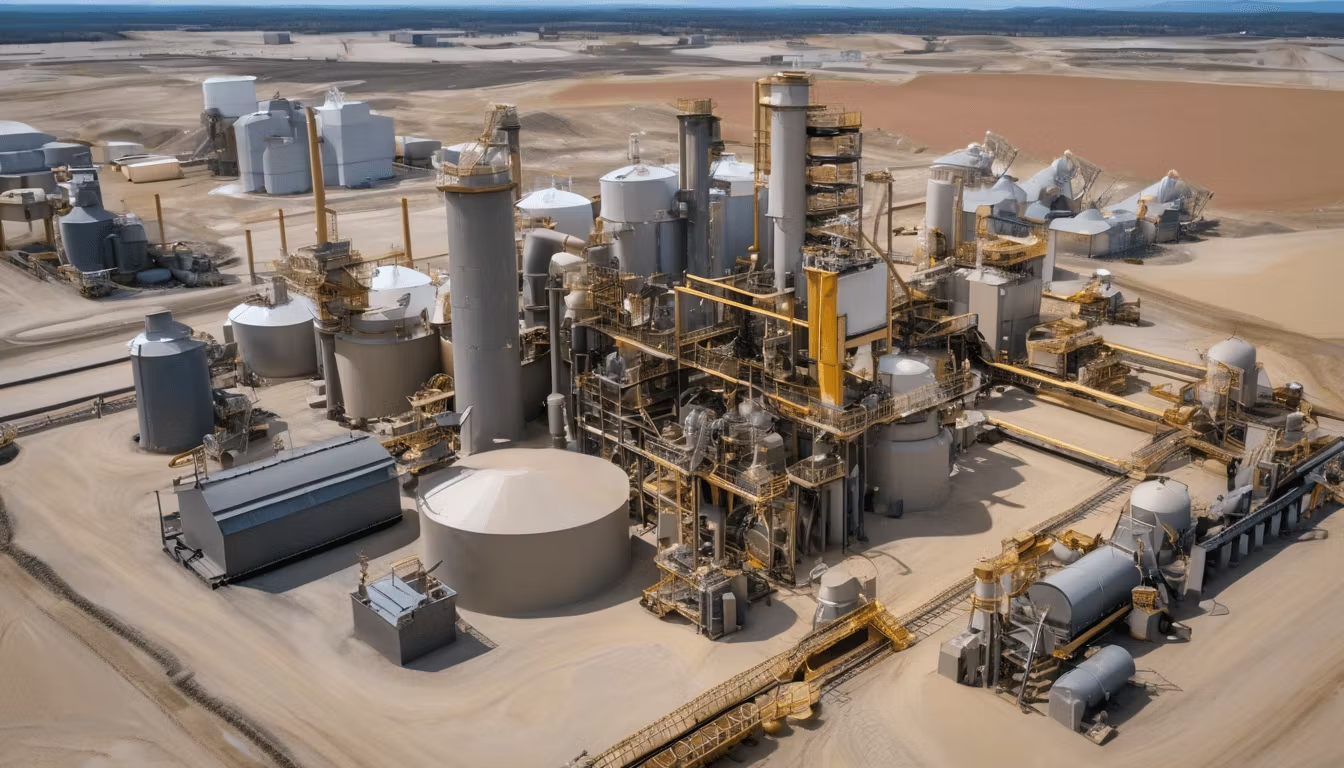
Commodity Price Risk Management: Hedging Strategies for Mineral Buyers

Introduction: Why Commodity Price Risk Management Matters for Mining Buyers
The global mining industry faces unprecedented price volatility. From nickel ore fluctuations that directly impact smelter profitability to silica sand price swings affecting glass manufacturers, commodity price risk has become a critical concern for B2B mining buyers.
For industrial buyers—whether you're sourcing minerals for manufacturing, construction, or processing—unpredictable commodity prices can erode margins, disrupt budget forecasts, and destabilize long-term business plans. A 15% spike in raw material costs can mean the difference between profitability and loss, particularly for margin-sensitive industries like ceramics, foundries, and water treatment.
This comprehensive guide explores practical commodity hedging strategies and price risk management techniques that help mining buyers navigate market volatility while maintaining supply chain stability.
Understanding Commodity Price Risk in the Mining Sector
What Drives Mineral Price Volatility?
Commodity prices—including nickel, silica, aluminium, and zircon—are influenced by multiple interdependent factors:
- Supply Disruptions: Mining accidents, regulatory changes, or export restrictions create sudden supply shocks. For instance, nickel ore export bans in key producing regions directly impact smelter availability and pricing.
- Demand Fluctuations: Economic cycles, construction booms, and manufacturing downturns shift buyer demand dramatically. A slowdown in automotive production immediately reduces demand for aluminium ingots and ferronickel.
- Currency Fluctuations: Commodity prices are typically denominated in USD, making exchange rate volatility a hidden cost for domestic buyers.
- Geopolitical Events: Trade tensions, sanctions, and policy changes create pricing uncertainty and supply chain disruptions.
- Seasonal Patterns: Mining operations in certain regions experience seasonal production variations, creating predictable price cycles.
The Cost of Unmanaged Price Risk
Without proper hedging strategies, mining buyers face several risks:
- Margin compression when input costs rise unexpectedly
- Cash flow volatility affecting working capital planning
- Competitive disadvantage against hedged competitors
- Difficulty in pricing finished products to customers
- Budget overruns and project delays
Core Commodity Hedging Strategies for Mining Buyers
1. Futures Contracts: The Foundation of Price Protection
Commodity futures allow buyers to lock in prices for future delivery, providing price certainty and protection against upward price movements.
How It Works: A glass manufacturer needing quartz sand in six months can purchase futures contracts at today's price, regardless of spot market movements. If prices rise, the futures position gains value, offsetting higher physical purchase costs.
Advantages:
- Price certainty for budgeting and forecasting
- Standardized contracts with transparent pricing
- High liquidity in major commodity exchanges (LME, COMEX, etc.)
- Effective for major commodities with active futures markets
Limitations:
- Nickel ore, being Indonesia-domestic only, lacks established futures markets
- Requires margin deposits and daily settlement monitoring
- Basis risk—the difference between futures and physical prices—still exists
- Overhedging can lock in unfavorable prices if market moves against expectations
2. Forward Contracts: Customized Price Agreements
Forward contracts are private agreements between buyers and suppliers to purchase commodities at a predetermined price on a future date. Unlike standardized futures, forwards offer flexibility tailored to specific needs.
Application for Mining Buyers: A foundry needing consistent aluminium ingot supply can negotiate a forward contract with a supplier like CV Indoalam Mineral Persada, fixing prices for 12-month supply while maintaining volume flexibility.
Advantages:
- Customizable terms matching operational requirements
- Direct relationships with suppliers eliminate intermediaries
- Ideal for non-standardized commodities or specific grades
- No exchange fees or margin requirements
Limitations:
- Counterparty credit risk—supplier default would impact supply and pricing
- Less liquid than exchange-traded futures
- Limited exit strategies if market conditions change
3. Options Strategies: Flexibility with Cost Control
Commodity options provide the right (but not obligation) to buy or sell at a specific price. They offer downside protection while preserving upside participation.
Common Option Structures:
- Call Options (Price Floor Protection): Buy the right to purchase at a set price. If market prices rise above the strike, exercise the option; if they fall, let it expire and buy cheaper in the spot market.
- Put Options (Price Cap Benefit): Buy the right to sell at a minimum price, protecting against price declines while allowing participation in price increases.
- Collar Strategies: Combine call and put options to establish a price range, reducing hedging costs by accepting limited upside potential.
Practical Example: A ceramic tile manufacturer facing zircon sand price uncertainty could purchase call options at $350/MT, paying a premium for price ceiling protection while maintaining upside benefits if prices fall below the strike.
4. Diversified Sourcing: Geographic and Supplier Redundancy
Strategic sourcing diversification reduces reliance on single suppliers or regions, providing natural price hedging through competitive pressure and supply alternatives.
Key Benefits:
- Negotiate better pricing through competitive tension between suppliers
- Mitigate supply chain disruptions through alternative sources
- Access different price points based on regional production costs
- Reduce impact of localized supply shocks
CV Indoalam Mineral Persada, with sourcing operations across multiple Indonesian regions—Sulawesi (Morowali, Konawe), Kalimantan, and Maluku (Halmahera)—provides buyers with geographic diversification and consistent supply across seasonal variations.
5. Spot-Plus Contracts: Balanced Price Participation
Spot-plus arrangements fix a portion of purchases at spot prices (immediate market) while securing another portion at forward prices, balancing price certainty with market participation.
Example Structure: A nickel smelter might commit to purchasing 40% of silica requirements at current spot prices and 60% at forward prices locked six months ahead, providing both flexibility and hedging.
Implementing Effective Commodity Price Risk Management
Step 1: Quantify Your Price Risk Exposure
Begin by measuring how much price volatility impacts profitability:
- Calculate the cost of materials as a percentage of total production costs
- Determine acceptable price ranges that maintain target margins
- Identify the maximum price increase you can absorb without impacting competitiveness
- Project annual volumes to establish hedging quantities
Step 2: Establish Hedging Objectives and Limits
Define clear hedging goals:
- Protection target: Do you want 100% price certainty or partial protection?
- Cost tolerance: What premium are you willing to pay for hedging (options costs, etc.)?
- Time horizon: What periods require protection (3-months, 12-months, multi-year)?
- Position limits: Set maximum hedging positions to avoid over-hedging
Step 3: Select Appropriate Hedging Instruments
Match hedging tools to your risk profile:
- Futures contracts suit major commodities with liquid markets and volatile prices
- Forward contracts work best for consistent suppliers with reliable quality (like CV Indoalam's SUCOFINDO-tested materials)
- Options provide flexibility when price direction is uncertain
- Diversified sourcing complements all other strategies
Step 4: Monitor and Rebalance Regularly
Effective hedging requires active management:
- Track actual vs. budgeted commodity prices weekly
- Monitor hedge position effectiveness through basis tracking
- Rebalance as operational volumes change
- Adjust strategies if market conditions or risk tolerance shift
Step 5: Communicate with Your Supply Chain Partners
Transparent communication ensures successful hedging execution. Working with reliable suppliers who offer flexible contract terms—volume adjustments, quality guarantees, SUCOFINDO testing, and IUP OPK licensing—eliminates supply-side surprises that can undermine hedging strategies.
Sector-Specific Hedging Considerations
For Nickel Smelters
Nickel smelters face unique hedging challenges. Since nickel ore export is restricted to domestic supply, international futures hedging is impossible. Instead:
- Lock in long-term supply agreements with licensed IUP OPK suppliers
- Use LME nickel futures to hedge the finished ferronickel/NPI output
- Diversify ore sourcing across Indonesian regions to stabilize input costs
For Glass and Ceramic Manufacturers
These industries rely heavily on silica sand and zircon sand inputs. Recommended strategies:
- Establish annual volume contracts with qualified suppliers to lock base pricing
- Use forward contracts for seasonal demand spikes
- Maintain safety stock to mitigate short-term price volatility
For Foundries and Metal Casters
Foundries consuming aluminium ingots and other metallurgical materials should:
Common Hedging Mistakes to Avoid
- Over-hedging: Protecting more volume than you actually need creates speculative positions and unneeded costs
- Ignoring basis risk: Futures prices don't perfectly track physical prices; basis movements can create losses despite correct directional bets
- Lack of strategy documentation: Hedging decisions made ad-hoc without clear policy lead to inconsistent and ineffective risk management
- Neglecting operational flexibility: Hedging shouldn't lock you into rigid supply commitments that prevent responding to demand changes
- Underestimating counterparty risk: With forward contracts and options, always assess supplier creditworthiness and financial stability
The Role of Supplier Partnerships in Commodity Risk Management
Your commodity hedging effectiveness depends significantly on your supplier relationships. Reliable, licensed suppliers who provide:
- Transparent, SUCOFINDO-tested quality assurance
- Flexible contract terms accommodating volume changes
- Direct-from-mine pricing without middleman markups
- Consistent supply across seasonal variations
...create a stable foundation for effective price risk management. Suppliers operating under IUP OPK licenses with RKAB approval demonstrate regulatory compliance and operational reliability, reducing counterparty risks inherent in hedging strategies.
Conclusion: Building a Resilient Commodity Hedging Program
Effective commodity price risk management combines multiple strategies: futures contracts for liquid commodities, forward agreements with trusted suppliers, options for flexibility, geographic diversification, and strong supplier partnerships. The optimal mix depends on your industry, commodity exposure, budget constraints, and price volatility tolerance.
Mining buyers who implement comprehensive hedging strategies—rather than reacting passively to price swings—maintain competitive margins, forecast costs accurately, and build predictable profitability even during volatile market cycles.
Ready to stabilize your commodity costs through reliable, qualified suppliers? Contact CV Indoalam Mineral Persada to discuss how our direct-from-mine supply, SUCOFINDO testing, and flexible contract terms can support your price risk management strategy across nickel ore, silica sand, aluminium ingots, and zircon sand.