B2B Mineral Trading in Indonesia: A Comprehensive Buyer's Guide
B2B Mineral Trading in Indonesia: A Comprehensive Buyer's Guide
Indonesia stands as one of the world's most significant sources of industrial minerals and mining commodities. For international and domestic buyers seeking reliable mineral suppliers, understanding the Indonesian mineral trading landscape is essential for securing consistent, high-quality supply chains. This guide explores the fundamentals of mineral trading in Indonesia, key products available, quality standards, and best practices for B2B mineral procurement.
Why Indonesia Is a Global Mineral Trading Hub
Indonesia's position as a leading mineral trading nation stems from several strategic advantages. The country possesses vast geological reserves of premium minerals, with deposits distributed across multiple regions including Sulawesi, Kalimantan, and Maluku. The Indonesian government has established comprehensive licensing frameworks—including IUP OPK permits and RKAB approvals—that create a structured environment for legitimate mineral trading and export operations.
For B2B mining buyers, Indonesia offers:
- Direct sourcing opportunities: Access to mines and primary producers without excessive middlemen costs
- Competitive pricing: Large-scale production capacity keeps commodity prices competitive in global markets
- Product diversity: Single suppliers often offer multiple mineral grades and types
- Regulatory compliance: Established certification systems (SUCOFINDO testing, ET Batubara approvals) ensure quality standards
- Production scale: Annual capacities reaching millions of metric tons enable large contract volumes
The Indonesian mineral trading sector connects major industrial sectors—from nickel smelters and glass manufacturers to ceramics producers and water treatment facilities—with consistent commodity supply.
Key Minerals Available for B2B Trading
Nickel Ore for Smelting Operations
Nickel ore represents one of Indonesia's most valuable mineral exports, though with specific market restrictions. Indonesian nickel typically comes in two primary forms: saprolite (higher grade, 1.5-2.0% Ni content) and limonite (lower grade, 0.8-1.2% Ni content). These materials supply major nickel smelters producing ferronickel, NPI (nickel pig iron), and HPAL (high-pressure acid leaching) products.
For international buyers, it's crucial to understand that Indonesia maintains export policies on nickel ore. However, domestic industrial buyers—smelters, refineries, and integrated producers—can source premium-grade nickel ore directly from licensed suppliers. Pricing typically reflects London Metal Exchange (LME) nickel prices plus processing margins.
Silica and Quartz Sand for Industrial Applications
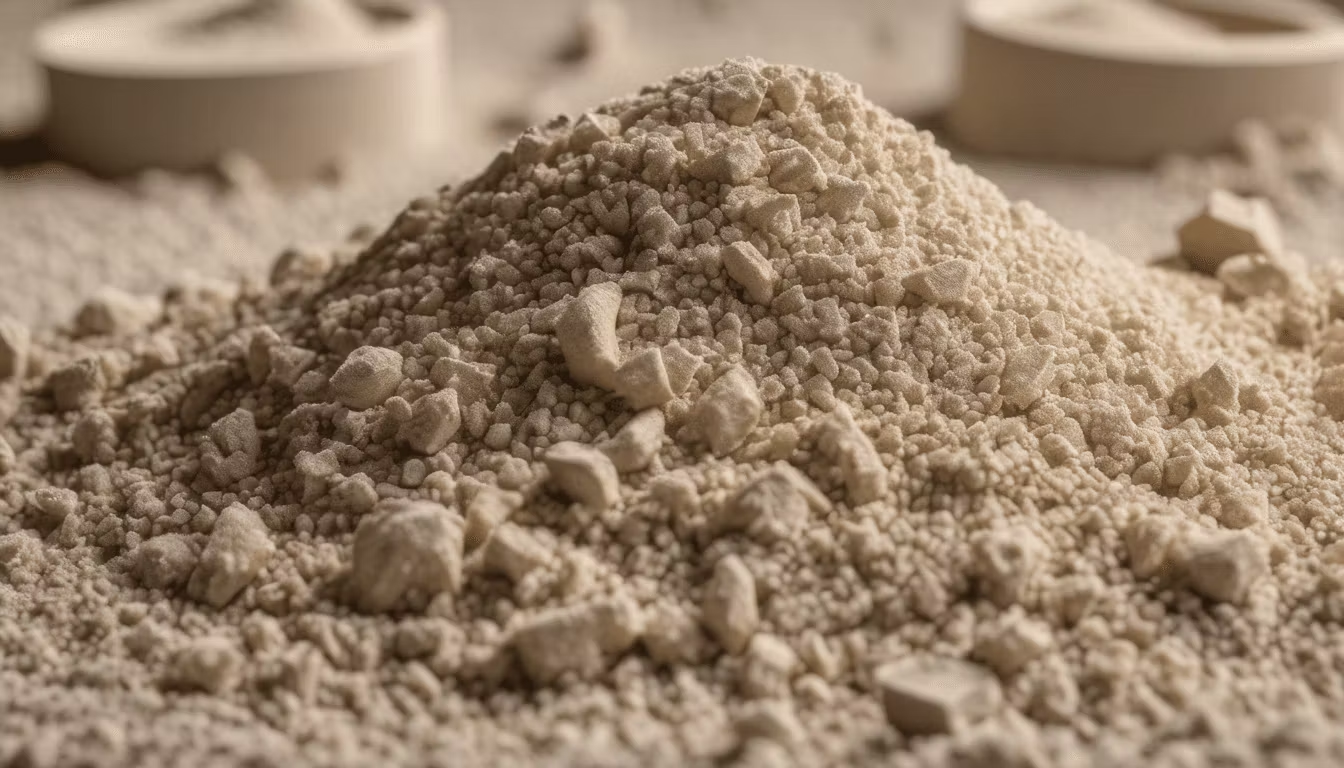
Silica sand serves dozens of industrial applications, making it one of the most versatile trading commodities. Indonesian silica products typically feature SiO2 content above 99%, available in multiple mesh grades (8 to 200) suited for different end-uses. Key markets include:
- Float glass manufacturing: Ultra-pure silica for transparent glass production
- Solar panels: High-purity sand for photovoltaic glass
- Water filtration: Graded sand for treatment system construction
- Foundry applications: Precision casting and molding sand
- Construction materials: Concrete aggregate and specialty fills
Unlike nickel ore, silica sand faces fewer export restrictions, making it accessible to both domestic and international buyers through legitimate B2B mineral trading channels.
Aluminium Ingot for Casting and Manufacturing
Aluminium ingot production in Indonesia supplies foundries, casting operations, and manufacturers across Asia-Pacific. Standard grades like ADC12 and A7 are readily available through mineral traders. These ingots serve as primary materials for automotive casting, engine blocks, and precision component manufacturing. Quality requirements typically include chemical composition certifications and dimensional consistency verification.
Zircon Sand for Advanced Applications
Zircon sand (ZrO2 65%+) serves specialized high-value applications including ceramics, refractories, and specialized foundry work. Due to higher pricing and lower production volumes compared to silica sand, zircon typically involves longer-lead sourcing and requires specific technical specifications for end-use compatibility.
Quality Standards and Certifications in Indonesian Mineral Trading
Professional B2B mineral trading relies heavily on standardized quality assurance. Indonesian suppliers operating under proper licensing maintain multiple certification levels:
SUCOFINDO Laboratory Testing
SUCOFINDO (Société Générale de Surveillance) operates as Indonesia's primary third-party testing authority for mineral commodities. Independent lab analysis confirms chemical composition, particle size distribution, moisture content, and impurity levels. SUCOFINDO certificates provide neutral quality verification that international buyers require.
IUP OPK Mining Licenses
The IUP OPK (Izin Usaha Pertambangan—Operasi Produksi Komersial) license represents Indonesia's primary mining operation permit. Licensed operators demonstrate environmental compliance, safety protocols, and regulatory adherence. This license covers mineral logam (metallic minerals), non-logam (non-metallic minerals), and bahan bakar (fuel materials).
RKAB Approval
RKAB (Rencana Kerja dan Anggaran Biaya—Work Plan and Budget) approval confirms annual mining and production activities have been submitted to and approved by Indonesian mining authorities. This documentation provides regulatory transparency for international trade transactions.
ET Batubara and Additional Certifications
For coal-adjacent mineral trading, ET Batubara (Coal Certificate) may apply. Additional certifications often include environmental compliance documentation and safety audit reports.
How to Find Reliable Mineral Suppliers in Indonesia
The B2B mining landscape includes both reputable operators and less-scrupulous traders. Buyer protection requires systematic supplier vetting:
Verify Licensing and Certifications
Request copies of IUP OPK permits, RKAB approvals, and ET Batubara certificates directly from suppliers. Cross-reference these documents with Indonesian mining ministry databases where publicly available. Licensed operations maintain updated certifications; any hesitation to provide documentation signals red flags.
Request Laboratory Test Results
Legitimate suppliers provide recent SUCOFINDO test results showing chemical composition and quality metrics. Request tests dated within 30-90 days of quotation. Third-party testing adds cost but ensures commodity specifications match buyer requirements.
Evaluate Production Capacity
Annual production capacity should match order volumes you're considering. Suppliers claiming capacity of 2.5 million metric tons annually should provide production records and customer references substantiating those claims. Capacity mismatches often indicate unreliable suppliers or inflated claims.
Assess Supply Chain Experience
Experience matters significantly in mineral trading. Established suppliers maintain relationships with major industrial buyers—nickel smelters, glass manufacturers, ceramics producers, water treatment facilities, and construction material manufacturers. Ask for customer references; legitimate suppliers readily provide them (with customer permission).
Logistics and Supply Chain Considerations
Successful B2B mineral trading depends on coordinated logistics. Key considerations include:
Transportation Methods
Most bulk minerals ship via bulk carrier vessels or container loads depending on volume and urgency. Domestic Indonesian buyers typically arrange trucking from mining regions (Sulawesi, Kalimantan, Maluku) to processing hubs or end-user facilities. Lead times vary: trial shipments (100 MT) might arrange within 2-4 weeks, while large contracts (hundreds of thousands of tons) require 8-12 week planning windows.
Storage and Handling
Minerals like silica sand require dry storage to prevent moisture degradation affecting quality certifications. Aluminium ingots need protection from oxidation. Nickel ore storage demands weatherproof facilities. Logistics planning should incorporate appropriate warehousing at origin, destination, and any transshipment points.
Documentation and Compliance
B2B mineral trading involves extensive documentation: purchase orders, quality certificates, shipping manifests, customs declarations, and destination port documentation. Working with suppliers familiar with Indonesian export procedures and international commodity trade regulations proves essential.
Pricing and Contract Negotiations
Mineral commodity pricing follows global benchmarks while reflecting supply chain costs and quality premiums. Understanding pricing mechanisms protects buyer interests:
Spot Pricing versus Contract Rates
One-off purchases typically follow spot market pricing, often benchmarked against commodity exchanges (LME for metals, various regional indices for industrial minerals). Long-term contracts (annual or multi-year) often negotiate fixed pricing with quarterly adjustment clauses tied to commodity indices.
Quality Premiums
Higher purity grades command premiums: 99.7%+ SiO2 costs more than 98% material; lower moisture content and tighter particle size distribution add value. Negotiate quality specifications aligned with end-use requirements—premium specifications cost more but may improve downstream manufacturing efficiency.
Volume Discounts
Significant order volumes (1,000+ MT) typically qualify for volume discounts. Suppliers with 2.5 million metric ton annual capacity can accommodate large contracts; pricing should reflect these economies of scale. Flexible supply arrangements—from 100 MT trial quantities to full annual contract volumes—allow cost-effective relationship building.
Best Practices for B2B Mineral Procurement
Professional mineral trading incorporates proven procurement practices:
- Start with trial shipments: Order small quantities (100-500 MT) to evaluate supplier reliability, product quality, and service responsiveness before committing to large contracts
- Obtain independent testing: Request SUCOFINDO or equivalent third-party testing for each shipment lot to confirm specifications
- Develop long-term relationships: Reliable suppliers build value through consistent quality, on-time delivery, and flexible accommodations for buyer needs
- Negotiate clear contracts: Written agreements should specify product grades, quality tolerances, delivery terms, payment schedules, and dispute resolution procedures
- Maintain supplier diversification: Relying on single suppliers creates supply chain vulnerability; cultivate relationships with multiple licensed operators
- Monitor market developments: Indonesian mining policy, export restrictions, and commodity prices fluctuate; stay informed through industry publications and supplier communications
Why Work With Professional Mineral Traders
Professional B2B mineral trading organizations offer advantages over direct mine negotiations: established quality systems, regulatory compliance expertise, logistics coordination, and customer service responsiveness. Reputable suppliers operating under complete licensing—IUP OPK, RKAB approval, SUCOFINDO testing—provide buyer protection and supply reliability.
Companies sourcing multiple minerals benefit from suppliers offering product portfolios. Rather than managing separate relationships for nickel ore, silica sand, and aluminium ingot purchases, consolidated suppliers streamline procurement, reduce administrative overhead, and provide volume synergies.
Getting Started With Indonesian Mineral Sourcing
Beginning B2B mineral trading with Indonesian suppliers follows a logical progression:
1. Define requirements: Specify mineral types, grades, quantities, and quality standards needed for your applications.
2. Research suppliers: Identify licensed operators in your target regions with appropriate capacity and certifications.
3. Request quotations: Get pricing for your typical order volumes with detailed specifications and delivery terms.
4. Verify credentials: Confirm IUP OPK licenses, RKAB approvals, and request recent SUCOFINDO test results.
5. Negotiate trial orders: Place initial small-volume purchases to evaluate supplier quality and reliability.
6. Establish contracts: Once satisfied, formalize long-term supply arrangements with clear terms and pricing mechanisms.
7. Contact suppliers directly to discuss your specific sourcing needs and explore customized solutions.
Conclusion: Finding Your Ideal Mineral Trading Partner
Indonesia's mineral trading sector offers legitimate buyers exceptional opportunities for reliable, competitively-priced commodity sourcing. However, success requires diligent supplier evaluation, understanding regulatory frameworks, and building relationships based on quality, compliance, and mutual benefit.
Leading B2B mineral suppliers combine comprehensive licensing (IUP OPK, RKAB, SUCOFINDO certification), substantial production capacity (millions of metric tons annually), product portfolio diversity, and customer service excellence. Whether you need nickel ore for smelters, industrial-grade silica sand, aluminium ingot for foundries, or zircon sand for specialized applications, professional traders operating under complete regulatory compliance provide the reliability that sophisticated B2B buyers demand.
CV Indoalam Mineral Persada exemplifies these standards—a licensed, professionally-operated mineral trading company providing direct-from-mine sourcing with comprehensive quality certifications, flexible supply arrangements, and proven reliability across industrial sectors. Whether exploring mineral trading opportunities or seeking established suppliers for consistent demand, connecting with properly-licensed, SUCOFINDO-tested operators protects your supply chain and supports your operational success.
Ready to source Indonesian minerals reliably? Contact an experienced mineral supplier today to discuss your specific requirements and explore customized sourcing solutions tailored to your industrial needs.