Automotive Die Casting Market: Aluminium Demand Surge

Automotive Die Casting Market: Growth Drivers and Aluminium Demand
The global automotive die casting market is experiencing unprecedented growth, with the sector projected to reach $27.4 billion by 2030. This expansion is driven by a fundamental shift in automotive manufacturing priorities: the transition toward lightweight vehicles, electric mobility, and stringent emissions regulations. At the heart of this transformation lies aluminium ingot demand, which continues to accelerate as manufacturers seek materials that deliver performance without weight penalties.
For B2B supply chain stakeholders—from foundries and die-casting operations to automotive component manufacturers—understanding this market trajectory is essential for strategic sourcing decisions and long-term competitiveness.
The Automotive Die Casting Market: Current State and Future Outlook
Die casting has become the manufacturing process of choice for automotive components that demand precision, durability, and cost-efficiency at scale. Unlike traditional machining or forging methods, die casting enables manufacturers to produce complex geometries with minimal material waste, making it particularly valuable in cost-sensitive automotive supply chains.
Market Size and Growth Trajectory
The automotive die casting market reached approximately $19.2 billion in 2023 and is accelerating with a compound annual growth rate (CAGR) of 6.8% through 2030. Asia-Pacific dominates this expansion, accounting for 42% of global market share, with China and Southeast Asia serving as manufacturing hubs for both domestic and international automotive brands.
Key drivers of this growth include:
- Electric Vehicle Adoption: EVs require 30-40% more aluminium per vehicle compared to traditional internal combustion engine vehicles, particularly for battery housings, thermal management systems, and structural components.
- Weight Reduction Mandates: Regulatory bodies including the European Union (targeting 93.6g CO₂/km emissions) and the United States (35.5 mpg fleet average) are forcing manufacturers to reduce vehicle curb weight.
- Cost Optimization Pressure: Die casting reduces production costs by 15-25% compared to alternative manufacturing methods, directly improving profit margins for OEMs and tier-one suppliers.
- Supply Chain Resilience: Manufacturers are diversifying sourcing regions away from traditional concentrated sources, creating opportunities for established suppliers in Southeast Asia.
Lightweight Vehicles: The Primary Market Driver
Lightweight vehicle engineering represents a seismic shift in automotive design philosophy. Where vehicles once gained safety and performance through heavier materials and larger engines, modern automotive engineering achieves these goals through material selection, design optimization, and component consolidation.
Weight Reduction Economics
For every 100 kg of weight reduction in a conventional vehicle, fuel consumption decreases by approximately 0.4-0.5 liters per 100 km. For electric vehicles, the impact is even more dramatic: a 10% reduction in curb weight extends driving range by 5-7%, a significant competitive advantage in consumer markets still concerned about EV range anxiety.
Die-cast aluminium components now appear throughout vehicle architectures:
- Engine blocks and cylinder heads
- Transmission housings and gear carriers
- Suspension components and steering knuckles
- Battery pack housings and thermal management systems
- Dashboard frames and door panels
- Structural reinforcement components
The average die-cast aluminium content per vehicle has increased from 47 kg in 2015 to 89 kg in 2023, with projections reaching 120-140 kg by 2028.
Material Performance Requirements
Automotive die casting demands specific aluminium alloy grades. The ADC12 (JIS standard) and equivalent A7 grades remain industry workhorses for general-purpose automotive components, offering excellent castability, mechanical properties, and cost-effectiveness. These alloys deliver tensile strengths of 160-230 MPa while maintaining the thermal conductivity essential for battery thermal management applications in electric vehicles.
Electric Vehicles and Aluminium Demand Surge
The electrification of the automotive sector represents the most significant demand catalyst for die-cast aluminium components in the 21st century. Unlike internal combustion engine vehicles, EVs require fundamentally different thermal management architectures and structural approaches.
EV-Specific Aluminium Applications
Battery Thermal Management: EV battery packs must maintain optimal operating temperatures (20-35°C) to maximize lifespan and performance. Die-cast aluminium housings with integrated cooling channels manage heat dissipation far more effectively than alternatives. Battery pack cases account for 8-12 kg of aluminium per vehicle.
Power Electronics Enclosures: Inverters, converters, and charging systems require robust, thermally conductive enclosures. Die-cast aluminium provides electromagnetic shielding, thermal conductivity (160-180 W/mK for ADC12), and structural integrity in compact form factors.
Motor Housing and Drivetrain Components: EV motor housings and integrated gearbox components are increasingly manufactured through die casting, reducing assembly complexity and weight compared to welded steel alternatives. A single integrated motor housing can weigh 15-20 kg less than traditional multi-part steel assemblies.
Market Impact: EV Growth Acceleration
Global EV sales reached 14 million units in 2023, representing 18% of total light vehicle sales. By 2030, industry analysts project EVs will comprise 35-45% of global light vehicle sales. This trajectory implies that EV-specific die-cast aluminium demand will grow at 18-22% annually—more than three times the growth rate of traditional automotive aluminium demand.
Supply Chain Implications for B2B Buyers
Raw Material Sourcing and Quality Assurance
The accelerating automotive die casting market has created significant sourcing challenges. Foundries and automotive component manufacturers require aluminium ingot supplies that meet rigorous specification requirements: precise alloy composition, minimal impurities, consistent casting quality, and reliable logistics.
Key sourcing considerations include:
- Alloy Consistency: Automotive applications demand aluminium ingots with certified chemical analysis, typically meeting ASTM B26 or equivalent international standards.
- Traceability and Certification: Original Equipment Manufacturers (OEMs) increasingly demand documented supply chain traceability, laboratory testing certification, and ISO 9001 or TS 16949 compliance from material suppliers.
- Logistics and Lead Times: Just-in-time manufacturing philosophies require suppliers capable of consistent, predictable delivery schedules. Regional sourcing has become a competitive advantage.
- Price Volatility Management: Aluminium futures prices fluctuate significantly. Suppliers offering flexible pricing models and supply contracts help foundries manage cost uncertainty.
Regional Supply Dynamics in Southeast Asia
Southeast Asia has emerged as a critical aluminium supply region, with Indonesia, Thailand, and Vietnam establishing themselves as major processing and re-export hubs. The region benefits from proximity to automotive manufacturing clusters in Thailand, Indonesia, and Vietnam, enabling faster fulfillment and lower logistics costs compared to European or North American sourcing.
For regional foundries and die-casters, working with established local suppliers offers distinct advantages: reduced lead times (2-3 weeks versus 6-8 weeks from smelters), flexible order quantities (from trial batches to multi-container contracts), and deeper understanding of regional automotive supply chain requirements.
Beyond Die Casting: Integrated Mineral Supply Solutions
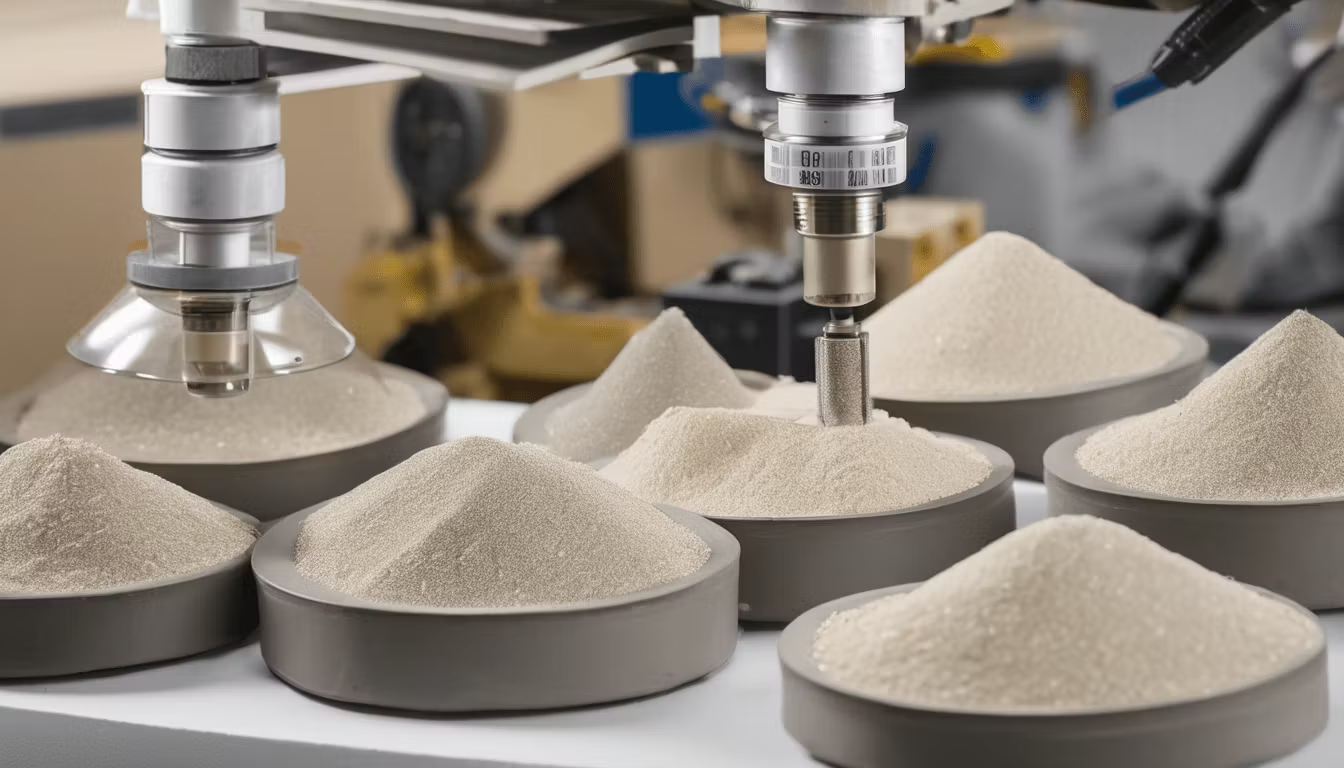
While aluminium ingots remain the primary focus for automotive die casting operations, progressive manufacturers recognize value in integrated supply partnerships. Advanced automotive manufacturing often requires complementary materials: silica sand for precision casting molds and cores, or specialized materials for thermal management and structural applications.
Leading suppliers now offer vertically integrated solutions that simplify procurement complexity and ensure material compatibility across the manufacturing process.
Competitive Advantages for Modern Suppliers
Quality Assurance and Testing
The most reliable aluminium ingot suppliers implement rigorous quality control protocols. Independent laboratory testing (such as SUCOFINDO certification) ensures alloy composition accuracy, mechanical properties verification, and impurity detection before material reaches foundries.
Direct Sourcing Models
Suppliers who maintain direct relationships with primary aluminium producers and possess full import/export licensing (including IUP OPK mineral permits and RKAB approvals in Indonesia) eliminate intermediary markups while ensuring supply continuity and material traceability.
Flexible Supply Capacity
Foundries often operate with variable production demands across product seasons. Suppliers offering flexible order quantities—from trial batches of 100 metric tons to annual contracts of 2.5 million metric tons—provide essential operational flexibility that enables innovation and risk management.
The Path Forward: Market Opportunities and Strategic Positioning
The automotive die casting market's growth trajectory presents significant opportunities for well-positioned suppliers. Several strategic trends will shape the competitive landscape through 2030:
Localization of Supply Chains: OEMs and tier-one suppliers are deliberately diversifying away from concentration in single regions. This creates enhanced opportunities for established suppliers in Southeast Asia and India.
Sustainability and Circular Economy Integration: Increasingly, automotive manufacturers demand material suppliers who can document sustainable sourcing practices and support circular economy initiatives (recycled aluminium content, ethical sourcing documentation).
Quality Standardization: As automotive electrification accelerates, material specifications for EV components are becoming more stringent. Suppliers who invest in quality infrastructure and testing capabilities will capture premium margins.
Logistics Innovation: Advanced logistics capabilities—including real-time inventory tracking, predictive delivery scheduling, and supply chain visibility platforms—differentiate mature suppliers from commodity merchants.
Conclusion: Positioning Your Supply Chain for Growth
The automotive die casting market's expansion, driven by lightweight vehicle mandates and electric vehicle proliferation, represents one of the most robust growth opportunities in industrial materials. For foundries, die-casters, and automotive component manufacturers, success in this environment requires reliable sourcing partners who combine product quality, supply consistency, and deep understanding of automotive supply chain requirements.
The transition to electric vehicles will accelerate aluminium demand for the next decade, with particular emphasis on thermal management components and battery housings. Manufacturers who secure reliable, certified aluminium ingot supplies from established regional partners will maintain production continuity while managing cost volatility.
Whether you're optimizing supply contracts, developing new EV components, or expanding production capacity, the sourcing partner you choose directly impacts your competitive position. Look for suppliers who demonstrate full regulatory compliance, independent quality certification, and proven capacity to support your production timeline.
At CV Indoalam Mineral Persada, we specialize in providing certified aluminium ingots (ADC12 and A7 grades) to foundries and automotive component manufacturers across Southeast Asia. With full IUP OPK licensing, SUCOFINDO laboratory certification, and RKAB approval, we offer the regulatory compliance and quality assurance your supply chain demands. From trial quantities of 100 metric tons to annual contracts of 2.5 million metric tons, we provide the flexibility and reliability that modern automotive manufacturing requires.
Contact us today to discuss how our aluminium ingot supply partnerships can strengthen your automotive die casting operations and position your business for growth in the electric vehicle era.