Zircon Milling Process: From Sand to Flour and Opacifier
Understanding Zircon Milling: The Complete Process Guide
Zircon milling represents one of the most critical processing stages in the mineral value chain, transforming raw zircon sand into specialized industrial materials. For B2B buyers in ceramics, glass, and refractory applications, understanding the milling process is essential to sourcing the right material specifications and ensuring consistent product quality.
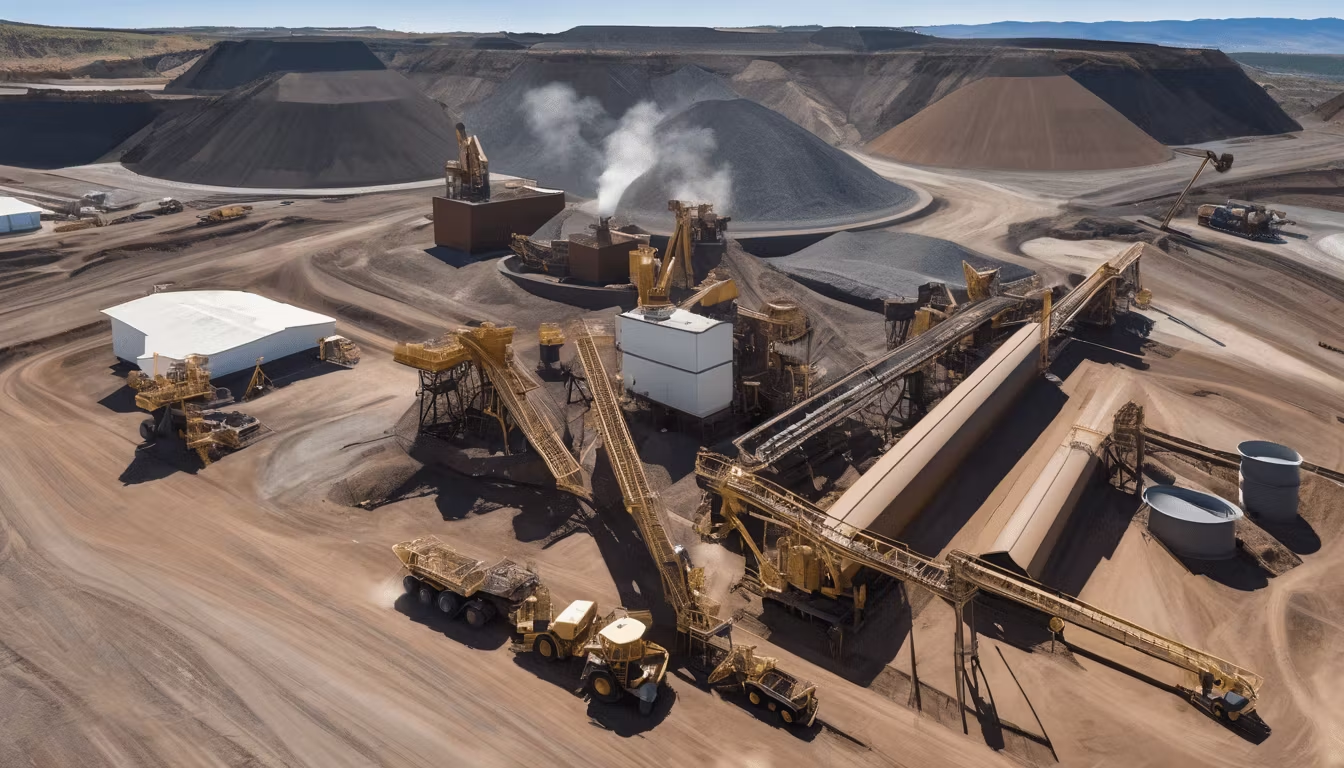
As a leading Indonesian mineral supplier with direct mining operations in Sulawesi, Kalimantan, and Maluku, CV Indoalam Mineral Persada specializes in premium zircon sand with ZrO2 content exceeding 65%. This blog post explores the complete zircon milling journey—from raw ore processing through to finished opacifiers—and how modern milling techniques deliver superior products for demanding industrial applications.
What is Zircon and Why Milling Matters
The Raw Material Foundation
Zircon (ZrSiO4) is a naturally occurring zirconium silicate mineral prized across multiple industries for its exceptional properties: high refractive index, thermal stability, chemical inertness, and opacity. In its raw form, zircon sand consists of grains ranging from coarse beach sand to fine particles, with varying levels of mineral purity.
The raw zircon sand we source from Indonesian deposits typically contains 65% to 70% ZrO2 content, meeting stringent SUCOFINDO laboratory standards. However, raw sand alone cannot serve most industrial purposes. Milling transforms this material into controlled particle sizes and specialized products like zircon flour and opacifiers.
Why Industrial Buyers Demand Milled Zircon
Different applications require different particle sizes and material specifications. Ceramicists need fine zircon flour for glazes and body formulations. Glass manufacturers require specific mesh grades for precision optical applications. Refractory producers demand ultra-fine zircon opacifiers for kiln linings and high-temperature materials. Milling enables suppliers like Indoalam to deliver tailored products meeting exact customer specifications.
The Zircon Milling Process: Step-by-Step
Stage 1: Raw Material Preparation and Screening
Before milling begins, raw zircon sand undergoes rigorous preparation. Materials are first inspected for contaminants—iron oxide, silica stones, and clay particles must be removed to ensure product purity. Primary screening separates oversized material and foreign matter using vibrating screens with mesh sizes typically ranging from 8 to 20 mesh.
At Indoalam, all raw materials are tested through SUCOFINDO certification protocols to verify ZrO2 content and mineral composition before processing. This quality control at the source ensures only premium-grade zircon enters the milling circuit.
Stage 2: Primary Grinding and Crushing
Prepared zircon sand enters primary grinding mills, commonly jaw crushers or cone crushers, which reduce particle size from raw beach sand (typically 8-12 mesh) to intermediate sizes (around 40-60 mesh). This stage breaks down larger agglomerates and creates uniform particle distribution for subsequent fine milling.
The crushing process requires precision control—excessive force can create unwanted fines (particles <200 mesh), while insufficient grinding leaves oversized particles. Modern mills employ adjustable chamber settings to optimize product gradation.
Stage 3: Fine Milling for Zircon Flour Production
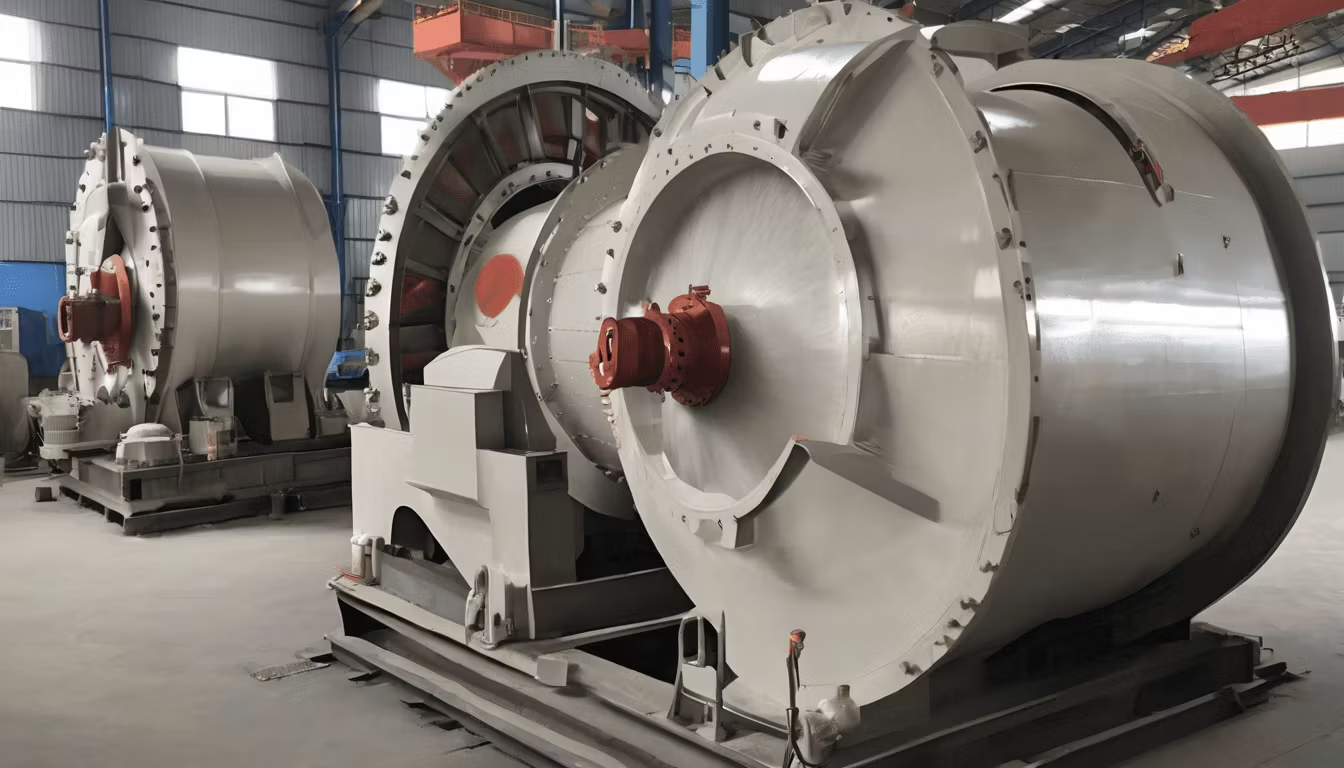
This is where raw zircon transforms into high-value zircon flour. Fine milling typically employs ball mills, rod mills, or specialized grinding mills designed for mineral processing. These systems rotate with zircon charge, using grinding media (ceramic or steel balls) to progressively reduce particle size through impact and attrition.
For zircon flour applications—primarily in ceramics and decorative tiles—target fineness typically ranges from 100 to 200 mesh, with some premium applications requiring sub-200 mesh particles. This stage consumes considerable energy; modern facilities optimize milling time to balance production efficiency with product specifications.
Stage 4: Classification and Particle Size Control
After milling, zircon particles span multiple size ranges. Classification systems separate material into precise mesh grades through hydrocyclones or air separators. This critical step ensures product consistency—buyers receiving zircon flour require narrow particle size distributions to maintain batch-to-batch performance in their applications.
Hydrocyclone classification works by centrifugal force, separating fine and coarse fractions simultaneously. Overflow (fine fraction) becomes refined zircon flour; underflow (coarser fraction) returns to mills for further grinding or is removed as specialty products.
Stage 5: Opacifier Production and Surface Treatment
For zircon opacifier applications—used extensively in ceramic glazes, white tiles, and glass formulations—the milling process incorporates specialized surface treatments. Micronized zircon particles (typically <10 microns) possess superior opacity compared to standard zircon flour because their smaller size increases light scattering efficiency.
Advanced facilities employ ultrafine grinding mills capable of producing zircon opacifiers with particle sizes below 5 microns. Surface coating treatments using silica or alumina may be applied to enhance opacity, prevent agglomeration, and improve dispersion in ceramic slips and glazes.
Stage 6: Quality Testing and Final Processing
Finished zircon flour and opacifiers undergo comprehensive testing: particle size distribution (laser diffraction), ZrO2 content (X-ray fluorescence), bulk density, oil absorption, and moisture content. Testing protocols comply with international standards (ISO, ASTM) and customer specifications.
UV whiteness testing is particularly important for opacifier grades—higher brightness values indicate superior opacity performance. Contamination testing via inductively coupled plasma (ICP) analysis ensures trace element levels remain below maximum thresholds for demanding applications.
Zircon Flour vs. Zircon Opacifier: Key Differences
Zircon Flour Specifications
Zircon flour represents the primary product of standard milling operations. Typical specifications include:
- Particle size: 100-200 mesh (median around 10-15 microns)
- ZrO2 content: 65-70%
- Bulk density: 2.3-2.5 g/cm³
- Moisture: <0.5%
- Applications: Ceramic glazes, tile bodies, foundry mold coatings, investment casting shells
Zircon Opacifier Specifications
Opacifier-grade zircon requires ultra-fine milling and specialized processing:
- Particle size: <5-10 microns (often <200 mesh classified)
- ZrO2 content: 65-70%
- UV Brightness: >95%
- Oil absorption: 15-20%
- Moisture: <0.3%
- Applications: White ceramic glazes, float glass opacifiers, high-opacity coatings, solar panel components
The primary difference lies in fineness and surface properties. Opacifiers demand more intensive milling and stricter particle size distribution control, commanding premium prices in international markets. Their superior light-scattering efficiency enables ceramic manufacturers to reduce zircon dosages while maintaining opacity—offering cost advantages despite higher per-ton material costs.
Industrial Applications Driving Milling Demand
Ceramic and Tile Manufacturing
Asia's booming ceramic tile industry—particularly in Indonesia, Vietnam, and China—consumes vast quantities of zircon flour and opacifiers. Manufacturers use zircon in glazes to achieve white, opaque finishes without titanium dioxide, and in body formulations for strength and whiteness. Modern tile applications specify precise particle sizes to ensure uniform glaze melt and opacity development in kiln firing.
Glass and Optical Applications
Float glass manufacturers incorporate zircon opacifiers in formulations requiring whiteness and chemical resistance. Solar panel manufacturers use specialized zircon grades in anti-reflective coatings. The ultra-high purity requirements in these applications demand milling facilities with stringent contamination controls.
Refractory and High-Temperature Materials
Zircon flour serves as a primary refractory material in kiln linings, furnace crucibles, and high-temperature thermal barriers. Its exceptional thermal stability (melting point ~2550°C) and chemical inertness make it invaluable in steelmaking, aluminum smelting, and ceramic firing applications. Specialized fine-grinding produces zircon flour tailored for specific thermal cycling requirements.
Investment Casting and Foundry Applications
Precision investment casting relies on zircon sand and flour as primary components in ceramic shell molds. The material's thermal stability, low thermal expansion, and chemical inertness enable production of complex metal castings with minimal defects. Foundries specify particular mesh grades and particle size distributions to optimize shell strength, permeability, and surface finish quality.
Quality Control in Zircon Milling Operations
Laboratory Testing Protocols
Professional milling facilities maintain in-house laboratories or partner with certified testing centers. CV Indoalam works with SUCOFINDO, Indonesia's leading inspection and certification body, to verify all material specifications. Testing includes:
- Chemical analysis: ZrO2, SiO2, TiO2, Fe2O3, Al2O3 content via XRF
- Particle size: Laser diffraction (Malvern Mastersizer) for precise distribution
- Physical properties: Bulk density, apparent density, oil absorption
- Contamination screening: ICP analysis for trace metals and impurities
- Brightness and opacity: UV-Vis spectrophotometry (Hunter Lab values)
Process Optimization and Consistency
Modern milling operations employ advanced process control systems monitoring mill performance in real-time. Parameters tracked include grinding mill rotation speed, product residence time, temperature, and grinding media wear rates. Automated feedback systems adjust milling conditions to maintain consistent particle size distribution across production batches.
Environmental controls are equally critical—milling produces substantial airborne dust requiring capture systems to meet emission standards and protect worker health. Proper dust control prevents product contamination and ensures accurate particle size measurements in quality testing.
Sourcing Premium Zircon Sand: A Buyer's Perspective
Direct Mining vs. Trading Operations
When selecting a zircon supplier, buyers should prioritize operations with direct mining access and comprehensive quality control. Middleman traders introduce inconsistency and unverifiable sourcing claims. CV Indoalam operates with direct IUP OPK (Integrated Mineral Business License) mining rights in premium deposits across Sulawesi, Kalimantan, and Maluku—ensuring supply chain transparency and consistent material quality.
Our mining operations produce raw zircon sand exceeding 65% ZrO2 content, which our milling facilities transform into specialized products meeting international standards. This integrated approach—from mine to finished product—eliminates intermediaries and enables flexible supply arrangements from trial quantities (100 MT) to major contracts (2.5M MT annually).
Specifications and Certifications Matter
Industrial buyers should demand SUCOFINDO-tested materials with documented particle size distributions, chemical analysis reports, and brightness values (for opacifier grades). Reputable suppliers provide technical data sheets with each shipment, enabling buyers to verify conformance to purchase specifications.
Traceability documentation—including mining source location, processing date, and batch testing results—provides assurance of material authenticity and enables quality investigations if issues arise.
The Economics of Zircon Milling
Production Costs and Pricing Factors
Zircon milling represents a capital-intensive operation. Modern mills, classification systems, testing laboratories, and dust control equipment demand substantial investment. Operating costs include grinding media, energy consumption, labor, maintenance, and environmental compliance.
Opacifier-grade zircon commands premium pricing (typically 15-25% above standard flour prices) due to ultra-fine milling requirements and more stringent testing protocols. International markets recognize opacifier grades through established pricing mechanisms; bulk zircon flour trades at commodity prices influenced by supply-demand dynamics and competing materials (titanium dioxide, aluminum silicates).
Supply Chain Efficiency
Integrated suppliers like Indoalam achieve cost advantages through vertical integration—controlling mining, milling, and quality assurance under single management. This reduces intermediary markups and enables rapid customization of particle sizes and specifications for customer requirements.
Comparing Zircon with Alternative Materials
Zircon vs. Silica Sand in Industrial Applications
While silica sand serves numerous applications requiring pure SiO2 (glass manufacturing, water filtration, sandblasting), zircon offers distinct advantages for high-temperature and opacity-critical applications. Zircon's superior refractive index provides superior opacity; its thermal stability exceeds silica sand; its chemical inertness in molten metal environments surpasses most alternatives.
Pricing typically favors silica sand for commodity applications, while zircon commands premium prices for specialized uses where its unique properties deliver measurable performance advantages.
Zircon vs. Titanium Dioxide Opacifiers
Ceramic and glass manufacturers often evaluate zircon opacifiers against rutile titanium dioxide. TiO2 offers superior opacity per unit mass but carries higher per-ton costs. Zircon provides competitive opacity at lower costs, particularly for applications where thermal stability and refractory properties matter. Environmental regulations increasingly favor zircon over TiO2 in certain applications, driving demand growth.
Future Trends in Zircon Milling Technology
Advanced Grinding Technologies
Emerging milling technologies offer improvements in energy efficiency and product consistency. Stirred media mills and grinding beads enable finer particle production with reduced energy consumption. Wet milling—using water-based grinding media—produces narrower particle size distributions compared to dry milling but requires additional drying stages.
Sustainability and Environmental Compliance
Modern milling facilities increasingly adopt circular economy principles, recovering grinding media, minimizing water usage, and capturing airborne dust for reuse or proper disposal. Energy-efficient motor systems and process optimization reduce carbon footprints—important considerations for international buyers facing environmental procurement standards.
Specialized Coatings and Surface Modifications
Advanced suppliers develop surface-treated zircon products with enhanced performance characteristics. Silica coatings improve flowability in glaze suspensions; alumina coatings enhance thermal shock resistance in refractory applications. These value-added products command premium pricing while delivering superior customer performance.
Selecting Your Zircon Milling Partner: Key Considerations
Operational Capacity and Supply Flexibility
Evaluate supplier capacity against your volume requirements. Indoalam maintains 2.5 million metric tons annual production capacity with flexible supply arrangements accommodating trial quantities (100 MT for new customers) through major contracts (multi-year agreements). This flexibility proves invaluable for manufacturers testing new applications or scaling production.
Technical Support and Customization
Leading suppliers provide technical consultation, assisting customers in optimizing zircon specifications for their particular applications. Request samples in your required particle sizes; conduct trial batches before committing to large purchases. Technical partnerships often reveal opportunities for material optimization improving customer product performance and profitability.
Quality Assurance and Traceability
Insist on comprehensive documentation including SUCOFINDO certificates, particle size distribution reports, and chemical analysis. Ensure suppliers maintain batch traceability, enabling investigation of any quality discrepancies. Long-term supply relationships depend on consistent material quality and transparent communication regarding specifications and performance.
Getting Started with Premium Zircon Sand and Milled Products
CV Indoalam Mineral Persada brings together direct mining operations, sophisticated milling capabilities, and rigorous quality control to deliver premium zircon flour and opacifier products meeting international specifications. Whether you require standard zircon flour for ceramic applications or specialized opacifiers for high-performance glass formulations, our team stands ready to support your requirements.
Our SUCOFINDO-certified materials, IUP OPK mining licenses, and RKAB-approved processing ensure supply chain transparency and material authenticity. We understand B2B industrial buyers demand reliable suppliers offering consistent quality, technical support, and flexible supply arrangements.
Contact us today to discuss your zircon requirements. Request samples, technical data sheets, and pricing for your specific application. Let Indoalam become your trusted source for premium Indonesian mineral products, delivered with the quality assurance and supply reliability your operations demand.
With operations across Indonesia's richest mineral deposits—Sulawesi, Kalimantan, and Maluku—combined with modern milling and processing facilities, Indoalam delivers zircon products engineered for industrial excellence.