Silica Sand Shipping: Container vs Bulk Carrier Guide
Silica Sand Shipping: Choosing Between Container and Bulk Carrier Options
The logistics of silica sand shipping represent one of the most critical decisions in your supply chain. Whether you're sourcing material from Indonesia's premier mining regions or managing international trade routes, understanding the differences between container shipping and bulk carrier transport is essential for optimizing costs, ensuring quality, and meeting delivery schedules. This comprehensive guide explores both methods, helping B2B buyers and suppliers make informed decisions about mineral logistics.
Understanding Silica Sand as a Bulk Commodity
Silica sand, also known as quartz sand, is a high-volume, low-value commodity that requires efficient transportation solutions. With annual production capacities reaching 2.5 million metric tons across Southeast Asian mines, the choice between shipping methods can significantly impact profit margins and operational efficiency. Industrial buyers—including glass manufacturers, foundries, ceramic producers, and water treatment facilities—depend on reliable bulk sand transport to maintain consistent operations.
The commodity nature of silica sand means that transportation costs often represent 15-30% of total landed expenses, making shipping method selection a strategic business consideration. Different end-use applications also require specific mesh grades (ranging from 8 to 200 mesh) and purity levels, which influence how material must be shipped and handled.
Container Shipping for Silica Sand Export
Advantages of Container Transport
Quality Preservation and Protection
Container shipping offers superior protection against environmental contamination and cross-contamination. This is particularly important for high-purity silica sand (SiO2 99.74%) destined for glass manufacturing or solar panel applications, where even minor impurities can affect product specifications. Sealed containers prevent salt spray, sea spray, and exposure to other cargo residues during voyage.
Flexibility and Smaller Volume Options
Containers accommodate smaller shipments, making them ideal for trial loads (100-500 MT) or customers with limited storage capacity. Twenty-foot (TEU) and forty-foot (FEU) containers provide standardized unit sizes that simplify documentation, port handling, and inland logistics. This flexibility enables traders to serve diverse customer bases without committing to full bulk carrier volumes.
Port Infrastructure Advantages
Container services operate from nearly every major port, reducing transit times through dedicated container terminals. Ports like Jakarta, Surabaya, Semarang, and regional Indonesian ports offer extensive container handling infrastructure, meaning shipments can move quickly to final destinations without waiting for specialized berths.
Easier Tracking and Documentation
Container shipments integrate seamlessly with modern supply chain tracking systems. Bill of lading documentation is standardized, and customs clearance procedures are well-established globally. This reduces administrative burden and improves visibility throughout the supply chain.
Disadvantages and Cost Considerations
Higher Per-Ton Shipping Costs
Container shipping costs approximately $100-200 per metric ton for Asian trade routes, compared to $15-40 per metric ton on bulk carriers. For high-volume buyers purchasing 500+ MT regularly, these per-unit premiums accumulate quickly. A 1,000 MT shipment via containers could cost $60,000-80,000 more than bulk carrier transport.
Weight Limitations
A standard 40-foot container can carry approximately 25-28 metric tons of silica sand due to volume constraints (containers fill before reaching maximum weight). This means multiple containers are needed for substantial volumes, compounding handling costs and reducing efficiency compared to bulk methods.
Cargo Handling Intensity
Container sand transport requires multiple handling operations: loading into containers, port handling, unloading at destination, and inland transport. Each transfer point introduces contamination risks and labor costs. Containers also require proper desiccant materials to manage moisture, adding expense.
Bulk Carrier Shipping for Mineral Logistics
Advantages of Bulk Carrier Transport
Dramatic Cost Advantages
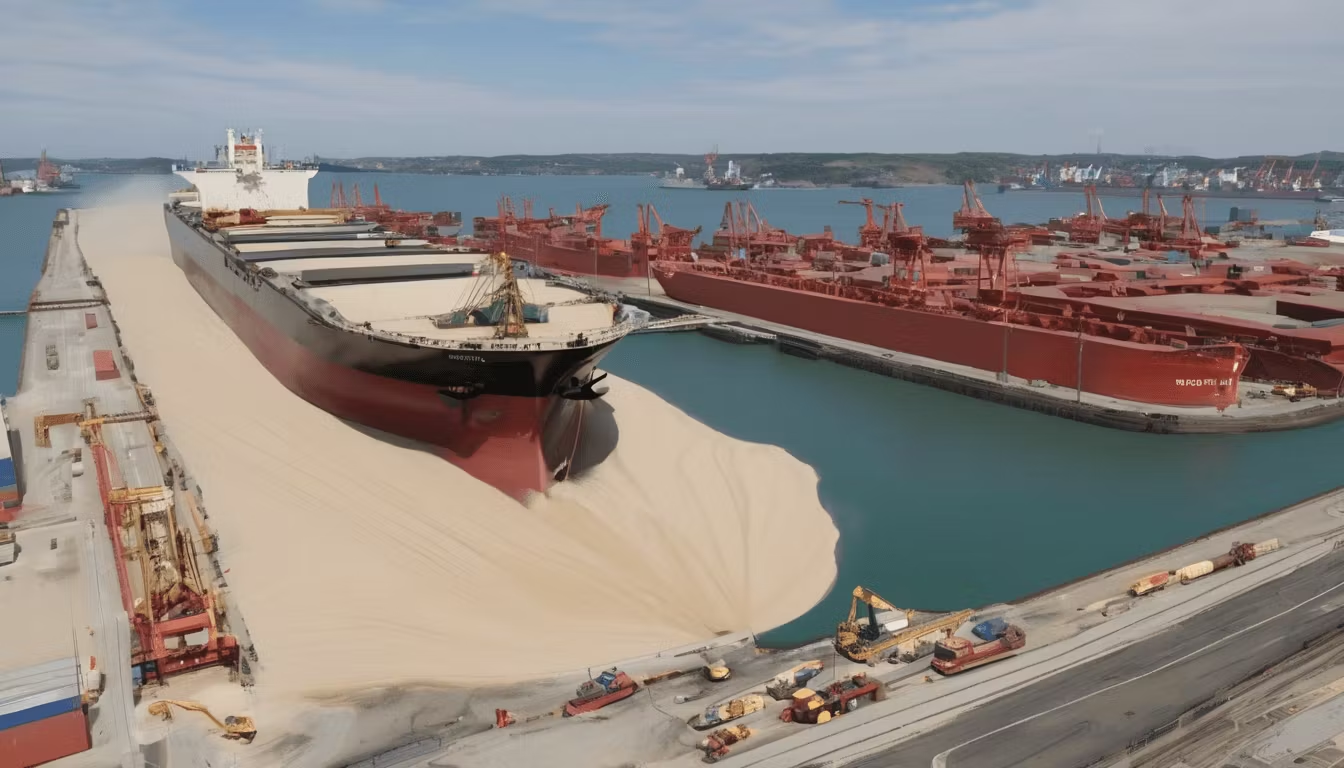
Bulk carrier shipping offers the lowest per-ton transportation costs, typically $15-40/MT for trans-Pacific and regional trades. A 2,500 MT shipment—representing the annual capacity of a medium-sized operation—costs $40,000-60,000 via bulk carrier versus $250,000-400,000 via containers. These savings directly improve competitiveness in commodity markets.
Higher Utilization and Volume Efficiency
Modern bulk carriers accommodate 30,000-60,000+ metric tons in single voyages. This consolidation eliminates repeated handling and port fees associated with multiple container movements. Shippers achieve 99% weight utilization compared to 85-90% for containers, maximizing revenue per voyage.
Simplified Logistics for Large Orders
Bulk carriers enable efficient movement of contract quantities: 500 MT minimum orders, 1,000-2,500 MT standard shipments, or annual contracts. This aligns perfectly with major buyer requirements—smelters, cement manufacturers, and industrial parks requiring consistent high-volume supply.
Faster Discharge and Handling
Bulk carriers discharge cargo using ship-mounted cranes or shore-based equipment, enabling rapid port turnaround (48-72 hours typically). This contrasts with container terminals, where congestion can extend wait times to 5-7 days during peak seasons.
Disadvantages and Challenges
Minimum Volume Requirements
Most bulk carriers require 500-1,000 MT minimum shipments, restricting access for smaller buyers. This limits market reach to larger industrial customers and may exclude emerging markets or new accounts requiring trial shipments.
Environmental Exposure Risk
Unlike sealed containers, bulk cargo sits exposed on deck or in open holds, vulnerable to sea spray, salt contamination, and weather exposure. Silica sand destined for ultra-high-purity applications (electronics, fiber optics) may not meet specifications after bulk ocean transit. Cover tarpaulins help but don't eliminate exposure completely.
Specialized Port Requirements
Bulk carriers need dedicated bulk terminals with appropriate cargo handling equipment. Not all ports offer bulk discharge facilities, potentially limiting destination options. Regional trade routes may require transshipment through hub ports, adding time and cost.
Less Flexible Scheduling
Bulk carrier sailings operate on fixed schedules typically weekly or bi-weekly. Shippers must consolidate cargo for scheduled voyages, potentially delaying urgent shipments if timing doesn't align.
Direct Comparison: Container vs Bulk Carrier Shipping
| Metric | Container Shipping | Bulk Carrier Shipping |
|---|---|---|
| Cost per MT (Asia-Pacific) | $100-200 | $15-40 |
| Minimum Order | 100-200 MT (flexible) | 500-1,000 MT |
| Typical Shipment Size | 250-1,000 MT | 1,000-5,000 MT |
| Environmental Protection | Excellent (sealed) | Moderate-Low (exposure) |
| Contamination Risk | Low (multiple handling) | Moderate (environmental exposure) |
| Port Availability | Extensive (most ports) | Limited (specialized terminals) |
| Transit Speed | Standard (5-14 days Asia) | Standard (5-14 days Asia) |
| Documentation Complexity | Standardized (easier) | Specialized (more detailed) |
Choosing the Right Shipping Method for Your Needs
Select Container Shipping When:
- Quality is paramount: Ultra-pure silica (99.8%+ SiO2) for glass, electronics, or specialized applications
- Volume is limited: Trial shipments, starter orders, or regional distribution networks under 500 MT
- Flexibility matters: Irregular demand or multiple smaller customers requiring direct delivery
- Destination ports lack bulk facilities: Smaller ports or emerging markets without specialized discharge equipment
- Higher margins justify costs: Premium-grade materials where customer willingness-to-pay justifies 15-25% logistics premium
Select Bulk Carrier Shipping When:
- Volume justifies efficiency: Orders exceeding 500 MT and regular ongoing supply (annual contracts)
- Buyers accept standard grades: Industrial-grade silica sand for ceramics, foundries, construction materials, water treatment
- Cost sensitivity is high: Commodity price competition where every percentage point of savings impacts margins
- Destination has bulk capacity: Major industrial ports and buyer facilities equipped for bulk discharge
- Consistent demand: Predictable, recurring shipments supporting fixed bulk carrier schedules
Regulatory and Quality Considerations in Mineral Logistics
Indonesian mineral logistics, including quartz sand transport, operate under strict regulatory frameworks. SUCOFINDO testing certifies material specifications before shipment, with results accompanying bulk and containerized cargo. IUP OPK licensing and RKAB approval ensure compliance with mining regulations, and these certifications remain valid regardless of shipping method.
However, shipping method choice affects quality documentation. Container shipments often benefit from pre-loading sampling and certification in sealed containers, creating stronger evidence of specification compliance for buyers subject to strict incoming quality protocols. Bulk shipments rely on pre-loading certifications and post-discharge sampling, which may show minor specification variation due to environmental exposure.
For buyers requiring specific mesh grades (8, 16, 30, 60, 100, 200 mesh), moisture content consistency, or iron oxide levels below specified thresholds, these quality requirements should inform shipping method selection and be explicitly written into supply contracts.
Integrated Logistics: Combining Methods for Optimal Efficiency
Leading B2B suppliers increasingly employ hybrid strategies: bulk carrier shipments to hub ports, followed by container redistribution to smaller regional buyers. This approach maximizes per-ton bulk savings while maintaining distribution flexibility. For example, a 5,000 MT shipment via bulk carrier to Singapore might be redistributed: 1,500 MT kept for Singapore/Malaysia customers, 2,000 MT containerized for Philippines markets, and 1,500 MT containerized for Thailand/Vietnam distribution.
This strategy requires reliable port partners and containerization capabilities at consolidation hubs, but delivers cost advantages across the entire supply network. Suppliers with established operations across multiple regions, sourcing from Sulawesi's Morowali and Konawe mining areas or Kalimantan deposits, can leverage regional consolidation for superior economics.
Practical Recommendations for B2B Buyers
Forecast Accurately: Bulk carrier cost advantages require volume commitments. Buyers should forecast 6-12 months of demand to justify bulk shipments and negotiate annual contracts that smooth cost over time.
Evaluate Total Landed Cost: Don't compare shipping rates in isolation. Include inland transport, port fees, handling charges, insurance, and storage costs. Sometimes container premium appears smaller when these additional costs are considered.
Specify Quality Requirements Clearly: Include purity targets, mesh grade specifications, moisture limits, and contamination thresholds in procurement specifications. Communicate these to suppliers before requesting quotes, as they directly affect shipping method recommendations.
Build Supplier Relationships: Suppliers with diverse logistics capabilities and regional consolidation infrastructure can often blend container and bulk services to meet unique requirements. Long-term partnerships enable custom arrangements that pure spot-market purchases cannot match.
Why Choose Indoalam for Your Silica Sand Supply
CV Indoalam Mineral Persada brings over a decade of combined trading experience and certified mining operations to B2B mineral logistics. Our 2.5 million metric ton annual silica sand capacity spans premium facilities across Sulawesi, Kalimantan, and Maluku's premier mining regions. Every shipment carries SUCOFINDO laboratory certification confirming specifications: SiO2 content up to 99.74%, consistent mesh grades (8-200), and quality assurance meeting smelter, glass manufacturer, and industrial customer requirements.
More importantly, we understand that one-size-fits-all logistics solutions don't serve diverse B2B customers. Whether you require trial shipments of 100 MT via container for feasibility testing, regular bulk carrier contracts of 1,500 MT monthly, or hybrid consolidated logistics across regional markets, we match supply and shipping methods to your operational needs and budget constraints.
Beyond silica sand, our integrated product portfolio—including nickel ore, zircon sand, and aluminium ingot—creates opportunities for consolidated shipments and cross-commodity logistics optimization. Our IUP OPK licenses, ET Batubara certification, and established relationships with major industrial buyers and smelters ensure reliable, compliant supply backed by proven execution.
Take the Next Step in Your Supply Chain
The right shipping method depends on your volume, quality requirements, budget constraints, and destination markets. Rather than choosing between container and bulk carrier options in isolation, consider how a trusted supplier partner can engineer integrated logistics solutions serving your complete needs.
Contact Indoalam today to discuss your silica sand requirements. Share your volume, specifications, and delivery locations, and let our logistics specialists recommend the most cost-effective and reliable shipping strategy for your operation. Whether you're a smelter securing consistent supply, a ceramic producer managing regional distribution, or an industrial buyer optimizing procurement costs, we're committed to matching supply with the right logistics solution.
Ready to optimize your mineral logistics? Reach out to our team and discover how Indoalam's integrated supply and logistics capabilities can strengthen your supply chain while protecting your margins.