Silica Sand Mesh Grades: Complete Guide to Selecting the Right Particle Size
Understanding Silica Sand Mesh Grades: The Complete Guide
Silica sand is one of the most versatile industrial minerals in the world, used across dozens of manufacturing sectors from construction to electronics. However, not all silica sand is created equal. The particle size—measured in mesh grades—plays a critical role in determining whether your silica sand will perform optimally in your specific application.
If you're sourcing silica sand for industrial use, understanding mesh grades isn't just technical jargon—it's essential for product quality, manufacturing efficiency, and cost-effectiveness. This guide will walk you through everything you need to know about silica sand particle sizing and how to select the right grade for your operation.
What Are Mesh Grades and How Are They Measured?
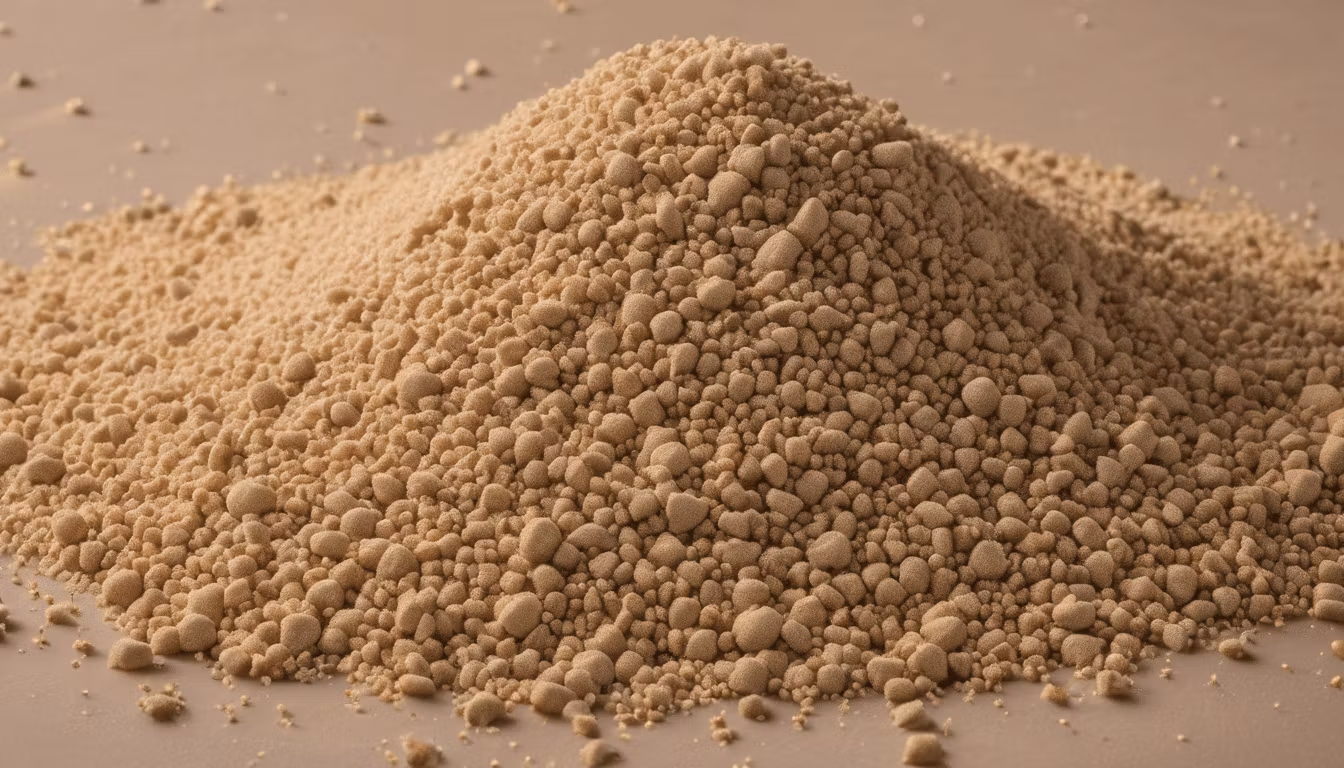
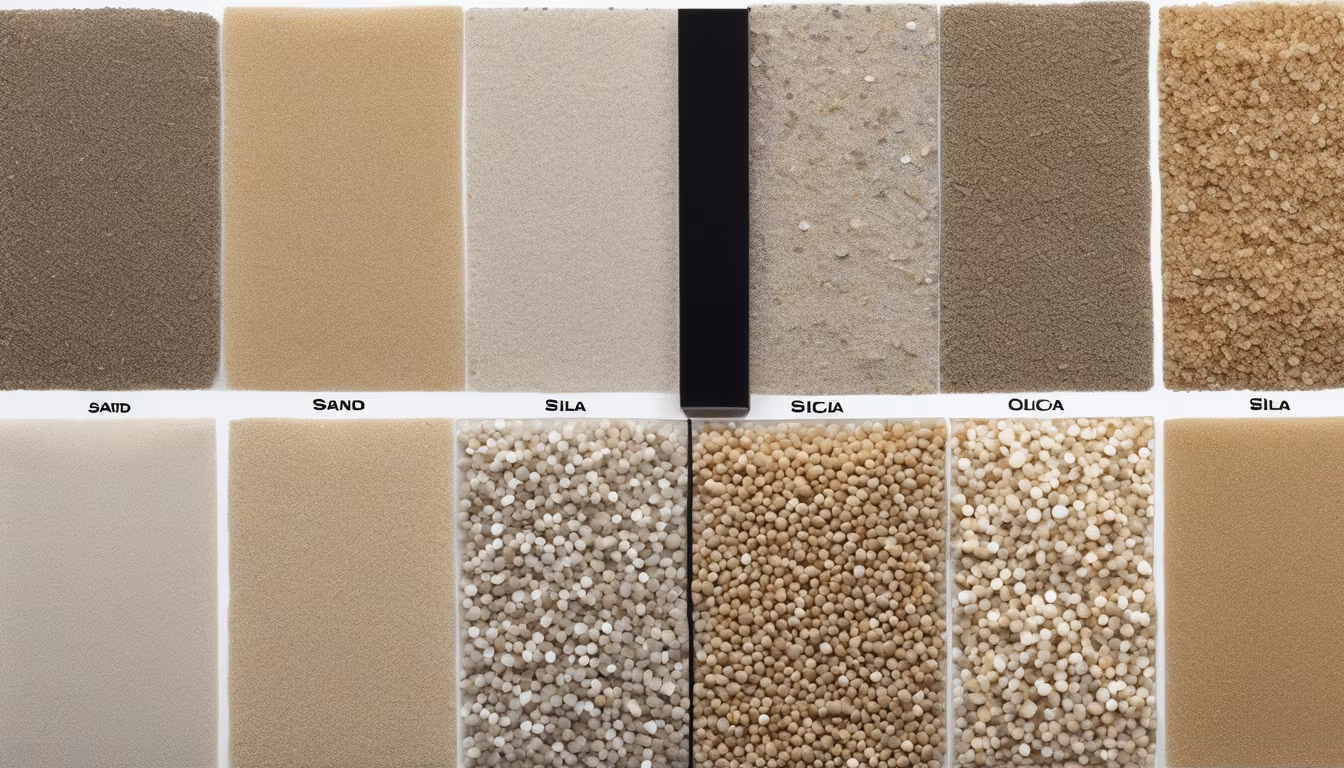
Mesh grades represent the number of openings per linear inch in a sieve screen. A higher mesh number indicates finer particles, while a lower mesh number indicates coarser particles. For example, 100-mesh sand passes through a screen with 100 openings per linear inch, while 200-mesh sand passes through a screen with 200 openings per linear inch.
The Mesh Grading System Explained
The mesh grading system follows the Tyler Standard Sieve Scale, an internationally recognized classification used across mining, minerals processing, and manufacturing industries. When you order silica sand by mesh grade, you're specifying a precise particle size range, typically within ±0.5 microns for high-grade applications.
CV Indoalam Mineral Persada sources and supplies quartz sand with SiO2 purity of 99.74% in multiple mesh grades ranging from 8 to 200, ensuring consistent quality that meets international standards. Each shipment is laboratory-tested by SUCOFINDO, Indonesia's leading independent testing and certification body, guaranteeing particle size accuracy and chemical composition.
Common Mesh Grades and Their Typical Applications
Understanding the relationship between mesh grades and applications is crucial for procurement decisions:
- 8-16 Mesh: Coarser grades used in foundry applications, concrete aggregates, and water filtration media.
- 20-40 Mesh: Medium-coarse grades ideal for glass manufacturing, ceramic glazes, and abrasive applications.
- 40-100 Mesh: Medium to medium-fine grades suitable for industrial coatings, glass beads, and precision castings.
- 100-200 Mesh: Fine to very fine grades used in high-precision applications including solar panel manufacturing, specialized glass formulations, and advanced ceramics.
Silica Sand Applications by Industry: Choosing Your Optimal Mesh Grade
Glass Manufacturing
The float glass and glassware industries are among the largest consumers of high-quality silica sand. For standard float glass production, manufacturers typically specify 40-100 mesh grades, which provide optimal melting characteristics and product clarity. Finer grades (100-200 mesh) are preferred for specialized applications like solar panels and precision optical glass, where particle uniformity directly impacts product performance and light transmission properties.
The finer mesh grades ensure minimal contaminants and consistent thermal behavior during the melting process, reducing defects and improving overall production yields.
Ceramics and Tile Production
Ceramic manufacturers require precise particle size distribution to achieve desired porosity, strength, and aesthetic properties in finished tiles. Medium grades (40-80 mesh) are standard for structural ceramics and floor tiles, while finer grades support specialized glazing and decorative tile applications. The particle size affects both the drying rate of ceramic bodies and the surface finish quality of glazed products.
Foundry Operations
Foundries utilize silica sand as a molding material in metal casting processes. Coarser grades (8-40 mesh) are preferred for foundry applications because they provide better permeability, allowing gases to escape during casting and reducing porosity defects. The larger particle size also improves mold strength and reduces casting surface roughness, ultimately lowering finishing costs.
Water Treatment and Filtration
Water treatment facilities rely on silica sand for both mechanical filtration and as a filter media base. Medium grades (20-60 mesh) are standard for municipal water treatment, while coarser grades (8-20 mesh) work well for industrial pre-filtration stages. The particle size directly affects flow rates, filtration efficiency, and backwash requirements.
Industrial Coatings and Abrasives
Fine to very fine mesh grades (100-200 mesh) are essential for industrial coating applications where surface smoothness and film quality are critical. In abrasive applications, the mesh grade determines cutting efficiency and surface finish characteristics of the abraded material.
Technical Factors in Mesh Grade Selection
Particle Size Distribution
While mesh grade specifies a nominal size, quality suppliers provide detailed particle size distribution (PSD) data showing the percentage of particles within specific ranges. A narrow PSD ensures consistent performance, while a wide distribution can lead to processing variability. Always request PSD analysis reports from your supplier—CV Indoalam provides SUCOFINDO-certified analysis with every shipment.
Bulk Density Considerations
Finer mesh grades typically have lower bulk densities than coarser grades, which affects shipping logistics, storage requirements, and handling equipment specifications. Coarser grades (8-20 mesh) may reach bulk densities of 1,550-1,600 kg/m³, while fine grades (150-200 mesh) might be 1,350-1,450 kg/m³. This 10-15% difference can significantly impact procurement costs and supply chain planning.
Roundness and Sphericity
Beyond mesh grade, particle shape influences application performance. Angular particles provide better mechanical interlock in foundry molds and concrete applications, while more rounded particles improve flow characteristics in some coating applications. Industrial suppliers provide shape analysis data for critical applications.
Silica Content and Purity Requirements
Different applications demand varying levels of SiO2 purity. Float glass typically requires 99.5%+ SiO2, while some abrasive applications accept 95-97% purity. Iron oxide and other trace elements become increasingly problematic in finer mesh grades, where impurities are more visible. Ensure your mesh grade selection aligns with your industry's purity specifications.
How to Specify the Right Mesh Grade for Your Operation
Step 1: Define Your Application Requirements
Begin by documenting your specific processing needs: Are you filtering, molding, coating, or aggregating? What are your finished product specifications? What flow rates and pressure drops can your equipment handle?
Step 2: Review Industry Standards
Consult applicable standards for your industry. Glass manufacturers should reference ASTM C144, ceramics producers should check ISO standards for particle size distribution, and foundries should follow AFS (American Foundry Society) guidelines. These standards typically recommend specific mesh ranges for optimal results.
Step 3: Request Sample Testing
Never commit to large-volume orders without testing samples. Request 25-50 kg samples in your target mesh grades and test them in your actual production environment. Measure processing efficiency, product quality, and waste rates. This validation step prevents costly errors and ensures compatibility with your existing equipment.
Step 4: Verify Quality Documentation
Demand comprehensive quality documentation including particle size distribution analysis, chemical composition reports, and moisture content data. Reputable suppliers like CV Indoalam provide third-party testing through SUCOFINDO, ensuring independent verification of all claims.
Cost Optimization Through Mesh Grade Selection
Finer mesh grades command premium prices due to additional processing costs. However, using excessively fine mesh grades for applications that don't require them wastes procurement budget. Conversely, specifying grades that are too coarse can increase waste and quality issues, ultimately raising per-unit costs.
Work with your supplier to optimize mesh grade selection based on your actual performance requirements rather than merely seeking the finest available grade. A 40-60 mesh silica sand may be perfectly adequate and significantly more cost-effective than 100-150 mesh for your specific application.
Consider total cost of ownership including freight (coarser material weighs more and ships cheaper per unit), handling equipment compatibility, and processing efficiency rather than simply comparing base material prices.
Why Mesh Grade Consistency Matters
Industrial buyers often overlook the importance of lot-to-lot consistency. Different mining operations, processing equipment, and quality control procedures can produce different PSD results even when nominally selling the same mesh grade. Inconsistent mesh grades lead to:
- Variable product quality and performance unpredictability
- Production line adjustments and efficiency losses
- Increased waste and rework requirements
- Quality control challenges and customer complaints
Establish long-term supplier relationships with documented quality metrics and consistent testing protocols. CV Indoalam maintains consistent mesh grading through standardized processing at licensed facilities and mandatory SUCOFINDO testing of every production lot.
Sourcing High-Quality Silica Sand with Precise Mesh Specifications
When sourcing silica sand for your industrial operation, partner with suppliers who understand your application requirements and can deliver consistent, documented quality. CV Indoalam Mineral Persada is an Indonesian B2B mineral trader specializing in high-purity silica sand with SiO2 content of 99.74%, available in mesh grades 8-200 for both domestic and international markets.
With IUP OPK licensing covering mineral, non-metal, and fuel commodities, SUCOFINDO testing certification, and RKAB approval, CV Indoalam ensures every delivery meets international quality standards. Our sourcing network across Sulawesi, Kalimantan, and Maluku provides supply security and consistency.
Whether you require 100 metric tons for trial runs or 2.5 million metric tons annually under long-term contracts, CV Indoalam delivers flexible supply options with transparent quality documentation. Our direct-from-mine sourcing eliminates middlemen, ensuring competitive pricing without compromising quality.
Additional Mineral Resources for Your Operation
Beyond silica sand, CV Indoalam also supplies complementary industrial minerals. If your operation involves metal casting, explore our aluminium ingot offerings in ADC12 and A7 grades. For specialized ceramic or refractory applications, inquire about our zircon sand products with 65%+ ZrO2 content.
Conclusion: Making the Right Mesh Grade Choice
Selecting the optimal silica sand mesh grade requires understanding your application requirements, industry standards, equipment capabilities, and total cost of ownership. The right mesh grade delivers superior product quality, improved processing efficiency, and reduced waste—directly impacting your bottom line.
Rather than defaulting to the finest mesh available, evaluate what your specific application actually demands and select accordingly. Partner with suppliers who provide comprehensive quality documentation, consistent lot-to-lot performance, and technical expertise to guide your specifications.
Ready to optimize your silica sand sourcing? Contact CV Indoalam Mineral Persada today to discuss your mesh grade requirements and request SUCOFINDO-certified samples. Our technical team will help you select the ideal specifications for your industrial application, ensuring quality, consistency, and cost-effectiveness for your operation.