Nickel Ore Moisture Content: How It Affects Pricing & Quality

Understanding Nickel Ore Moisture Content: A Critical Factor in B2B Mining
In the global commodities market, nickel ore has become one of the most strategically important minerals, driving the electric vehicle revolution and stainless steel production. However, many B2B buyers overlook a fundamental aspect of nickel ore quality assessment: moisture content. This seemingly technical specification has profound implications for pricing, shipping costs, processing efficiency, and ultimately, your bottom line.
Moisture content in nickel ore is not merely a quality metric—it's a pricing determinant that can swing contract values by 5-15% depending on moisture levels, ore type, and market conditions. Understanding how moisture content works, how it's measured, and how it influences pricing is essential for procurement teams, smelter operators, and commodity traders navigating the Indonesian nickel market.
What Is Nickel Ore Moisture Content?
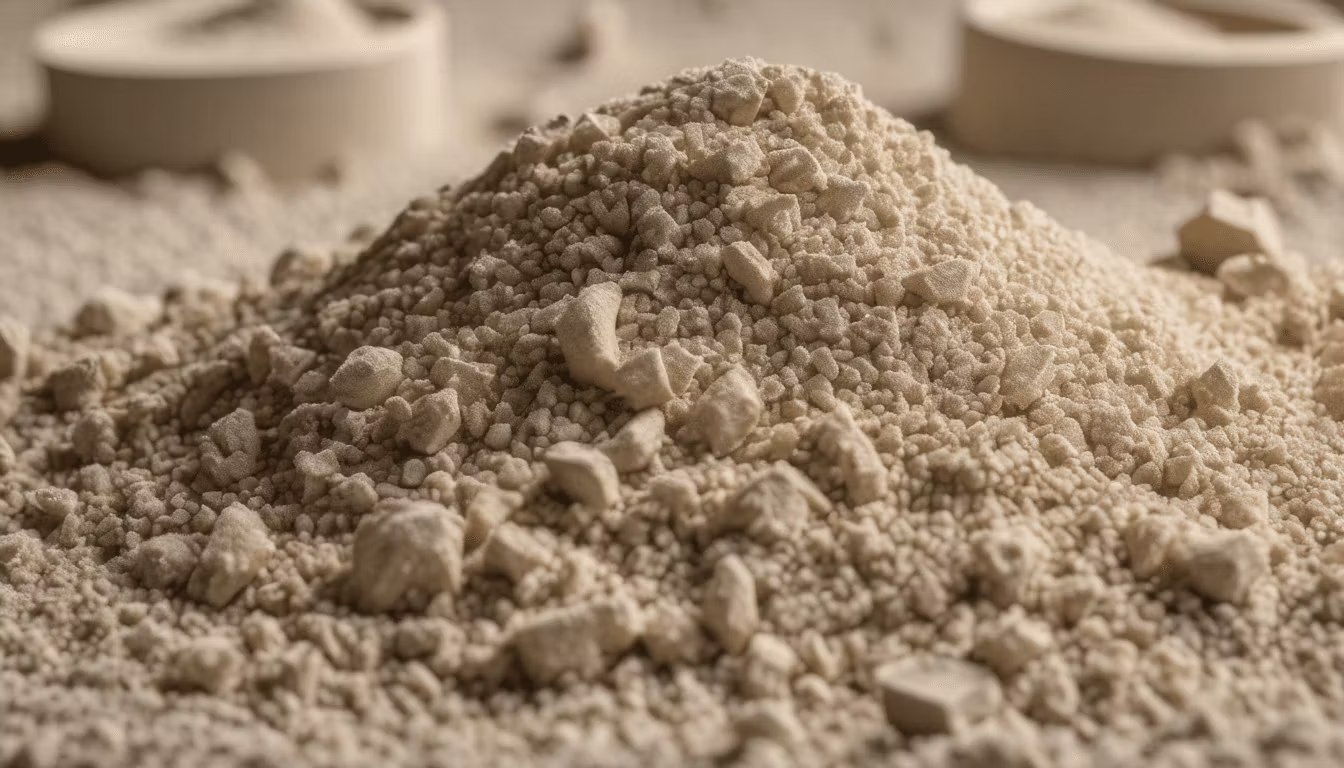
Moisture content refers to the percentage of water present in nickel ore samples, measured either as "in-situ moisture" (natural moisture as extracted) or "air-dry moisture" (after partial drying). In Indonesia's tropical climate, nickel ore naturally contains significant moisture due to heavy rainfall and humid conditions throughout Sulawesi, Kalimantan, and Maluku mining regions.
Indonesia produces two primary types of nickel ore:
- Saprolite Nickel Ore: Typically contains 8-18% moisture content, with nickel grades ranging from 1.5-2.0% Ni
- Limonite Nickel Ore: Generally exhibits 20-35% moisture content, with lower nickel grades between 0.8-1.2% Ni
These moisture ranges are industry-standard and directly correlate with the ore's geological origin. Saprolite ore, formed from weathered laterite deposits, naturally contains less moisture than limonite ore, which is derived from iron-rich oxide layers closer to the surface.
The Relationship Between Moisture and Wet Metric Ton Pricing
Understanding Wet Metric Ton (WMT) vs. Dry Metric Ton (DMT)
The distinction between wet metric ton (WMT) and dry metric ton (DMT) is fundamental to nickel ore pricing. When ore is quoted at a specific price per metric ton, buyers must clarify whether this price applies to WMT or DMT—a critical distinction that directly impacts contract costs.
Wet Metric Ton (WMT): The ore's weight as delivered, including all moisture content. For saprolite ore with 10% moisture, one metric ton of WMT contains approximately 0.9 metric tons of actual nickel-bearing minerals and 0.1 metric tons of water.
Dry Metric Ton (DMT): The ore's weight after complete moisture removal (theoretical or actual drying). This represents the "true" mineral content without water.
Real-World Pricing Impact
Consider this scenario: A buyer contracts for 10,000 metric tons of saprolite nickel ore quoted at $45 USD per WMT with 10% moisture content. The calculation looks like this:
- Contract Quantity: 10,000 WMT
- Moisture Content: 10%
- Effective DMT: 9,000 DMT (10,000 × 0.90)
- Total Cost: 10,000 × $45 = $450,000 USD
- Cost per Actual Mineral (DMT): $450,000 ÷ 9,000 = $50 USD/DMT
Now compare this to the same ore quoted at $50 USD per DMT: you pay exactly $450,000 for 9,000 DMT of actual mineral. The WMT price ($45) and DMT price ($50) are mathematically equivalent, but the distinction matters enormously when moisture content varies between shipments or regions.
How Moisture Content Affects Nickel Ore Logistics and Transportation Costs
Moisture content directly impacts shipping economics, particularly for long-distance international exports. Higher moisture content means heavier shipments, higher freight costs, and increased demurrage charges.
Shipping Weight Premiums
Limonite ore with 30% moisture content costs significantly more to transport than saprolite ore with 10% moisture. For a 25,000 DWT vessel:
- Saprolite at 10% moisture: 250,000 WMT capacity = 225,000 DMT of minerals
- Limonite at 30% moisture: 250,000 WMT capacity = 175,000 DMT of minerals
The limonite shipment delivers 50,000 fewer DMT of actual nickel ore despite filling the vessel completely. Shipping costs remain identical, but your effective cost per unit of mineral increases dramatically.
Port and Storage Considerations
High-moisture ore also incurs elevated port handling fees, storage costs, and potential demurrage charges if unloading is delayed by weather or congestion. Wet ore can consolidate during storage, creating uneven density and requiring re-handling for proper blending at processing facilities.
Processing and Smelting Implications of Moisture in Nickel Ore
Moisture content becomes operationally significant at nickel processing facilities. Smelters and laterite ore processors must account for moisture in their kiln operations, as water content affects:
Energy Consumption
Drying ore consumes substantial energy in rotary kilns and high-pressure acid leaching (HPAL) systems. Ore with 25% moisture requires 25% more thermal energy to reach target temperatures compared to 10% moisture ore, assuming identical nickel grades. For large-scale smelters processing 100,000+ metric tons monthly, this translates to significant operational cost differences.
Processing Yields and Recovery Rates
Excess moisture can negatively impact nickel extraction efficiency in pyrometallurgical processes. Laterite ore with high moisture content may experience lower nickel recovery rates (typically 65-75% for HPAL, 80-85% for rotary kiln electric furnace methods) compared to properly dried ore, where recovery rates approach 85-90%.
Quality Consistency
Ore with variable moisture content creates inconsistency in processing parameters. A batch arriving at 15% moisture behaves differently from the same ore type at 20% moisture, requiring constant kiln adjustments and potentially affecting ferronickel or nickel pig iron (NPI) grade consistency.
Market Pricing Dynamics: How Moisture Affects Nickel Ore Value
Benchmark Pricing and Moisture Adjustments
The London Metal Exchange (LME) and industry benchmarks typically quote nickel prices per metric ton of refined nickel content. However, raw ore transactions incorporate moisture-based adjustments called "penalty clauses" or "moisture deductions."
Standard industry practice:
- Saprolite ore priced at baseline if moisture is 10-12%; penalties apply if moisture exceeds 15%
- Limonite ore priced at baseline if moisture is 20-25%; penalties apply if moisture exceeds 30%
- Typical penalty: $2-5 USD per WMT for each percentage point above the baseline
A 5,000 WMT shipment of saprolite with 18% moisture (3% above baseline) could incur a $30,000-$75,000 penalty depending on market conditions and contract terms.
Seasonal Moisture Fluctuations
Indonesia's monsoon seasons (October-April) increase moisture content in fresh ore. Wet season ore often commands 3-8% price discounts compared to dry season material, even from the same mining operation. Savvy procurement teams time large contracts to avoid peak monsoon months when possible.
Quality Testing and Moisture Verification Standards
Reputable suppliers employ third-party laboratory testing to verify moisture content and prevent disputes. CV Indoalam Mineral Persada utilizes SUCOFINDO certification—Indonesia's premier independent testing company—to verify all moisture content claims and chemical composition before shipment.
Testing Methodology
Standard moisture testing follows ASTM D3302 or ISO 13909 standards:
- Oven drying method: Ore samples heated to 110°C until constant weight (typically 4-8 hours)
- Karl Fischer titration: Chemical analysis measuring free and bound water (more precise for research applications)
- Field moisture analyzers: Portable devices providing real-time moisture estimates at mining sites
Independent lab testing eliminates "wet-washing" practices where unscrupulous suppliers artificially increase ore weight by adding water before shipment. Professional mining companies conduct testing before loading, at port of origin, and often again at destination ports.
Selecting Nickel Ore Suppliers: Moisture Reliability as a Quality Indicator
When evaluating nickel ore suppliers for long-term contracts, moisture content consistency serves as a reliable quality indicator. Suppliers demonstrating tight moisture control (±2% variance) typically maintain superior standards across all quality parameters, including:
- Nickel grade accuracy and consistency
- Iron oxide contamination levels
- Silica and alumina ratios
- Delivery schedule reliability
Conversely, suppliers showing wide moisture content fluctuations (±5-10%) often lack proper quality control systems and logistics management, indicating potential risks for larger contracts.
Best Practices for Managing Nickel Ore Moisture in Your Supply Chain
Contract Specification Recommendations
Forward-thinking procurement teams include specific moisture provisions in supply contracts:
- Define baseline moisture percentage and acceptable variance range (e.g., "10-12% moisture, ±2% variance acceptable")
- Specify whether prices are quoted WMT or DMT with clear conversion methodology
- Include independent testing clauses with third-party lab confirmation before payment
- Establish penalty/credit mechanisms for moisture content outside acceptable ranges
- Define seasonal adjustments if contracts span multiple monsoon periods
Supply Chain Optimization
To minimize moisture-related costs and operational disruptions:
- Negotiate delivery terms: Request ore delivered at moisture content below baseline if possible (reduces penalty risk)
- Batch consolidation: Combine multiple smaller shipments to improve moisture averaging and reduce per-unit shipping costs
- Supplier diversification: Source from multiple regions (Sulawesi vs. Kalimantan) to balance seasonal moisture variations
- Pre-processing partnerships: Partner with local drying facilities for bulk moisture reduction before transport
Comparing Indonesian Nickel Ore to Global Alternatives
Indonesia's tropical climate means its nickel ore naturally exhibits higher baseline moisture than Philippine or Australian ore. However, Indonesian saprolite ore's superior nickel grades (1.5-2.0% Ni vs. 1.2-1.5% globally) often offset higher moisture-related costs when calculated on a per-nickel-unit basis.
For buyers also considering silica sand or aluminium ingot sourcing, Indonesian suppliers offer portfolio advantages by consolidating multiple mineral supply relationships, reducing overall supply chain complexity.
Why Partner with Indoalam for Moisture-Controlled Nickel Ore Supply
CV Indoalam Mineral Persada has established itself as a trusted nickel ore supplier precisely because we understand moisture content's business impact. Our operational advantages include:
- IUP OPK Licensed Operations: Full regulatory compliance across all sourcing regions (Sulawesi, Kalimantan, Maluku)
- Direct-from-Mine Sourcing: Eliminate middlemen and moisture-related logistics waste
- SUCOFINDO Lab Testing: Every shipment certified for moisture content, nickel grade, and contaminant levels before loading
- Flexible Supply Capacity: From 100 MT trial shipments to 2.5 million metric tons annually, with customized moisture specifications
- Consistent Quality Control: RKAB-approved mining plans ensure moisture monitoring throughout extraction and handling
Whether you operate a nickel smelter requiring 50,000 monthly metric tons of saprolite ore or manage a smaller operation needing quarterly trial shipments, Indoalam delivers reliable, lab-verified nickel ore with transparent moisture content documentation.
Conclusion: Making Informed Nickel Ore Purchasing Decisions
Moisture content represents far more than a technical specification—it fundamentally impacts your procurement costs, processing efficiency, and bottom-line profitability. Understanding the relationship between moisture, wet metric tons, and pricing enables B2B buyers to negotiate better contracts, identify supplier reliability, and optimize their entire supply chain economics.
By partnering with suppliers who maintain rigorous moisture control, conduct independent lab testing, and provide transparent documentation, you transform a potential cost liability into a competitive advantage. Contact Indoalam today to discuss your nickel ore requirements and discover how our quality assurance practices can optimize your sourcing strategy.