Automotive Die Casting Market: Growth Drivers & Aluminium Demand
The Automotive Die Casting Market: A Critical Overview
The global automotive die casting market is experiencing unprecedented growth, driven by the rapid shift toward lightweight vehicle manufacturing and the accelerating transition to electric vehicles (EVs). As original equipment manufacturers (OEMs) seek to reduce vehicle weight and improve fuel efficiency, die casting has emerged as the preferred manufacturing process for complex metal components. This trend directly impacts demand for high-quality aluminium ingot materials, making it essential for automotive suppliers to understand market dynamics and secure reliable material sources.
Die casting represents one of the most efficient methods for producing intricate metal parts with minimal waste and superior dimensional accuracy. Unlike traditional forging or machining processes, die casting allows manufacturers to create complex geometries in a single operation, significantly reducing production costs and time-to-market. For the automotive industry, this efficiency translates into competitive advantages that directly impact profitability and market positioning.
Market Size and Growth Projections
Current Market Valuation
The global automotive die casting market was valued at approximately USD 68 billion in 2023 and is projected to expand at a compound annual growth rate (CAGR) of 7.8% through 2030. This growth significantly outpaces traditional automotive manufacturing sectors, reflecting the fundamental shift in how vehicles are engineered and produced. Asia-Pacific dominates this market, accounting for over 45% of global production capacity, with China, India, and Southeast Asia emerging as critical manufacturing hubs.
Regional Growth Variations
North America and Europe are experiencing steady growth driven by stringent emissions regulations and consumer demand for fuel-efficient vehicles. However, Asia-Pacific's growth rate is substantially higher, fueled by lower labor costs, expanding domestic vehicle markets, and increasing OEM investment in manufacturing infrastructure. Indonesia, in particular, is positioned as a strategic location for die casting facilities due to its abundant raw material availability and growing automotive supply chain ecosystem.
Key Growth Drivers in Automotive Die Casting
1. Lightweight Vehicle Manufacturing
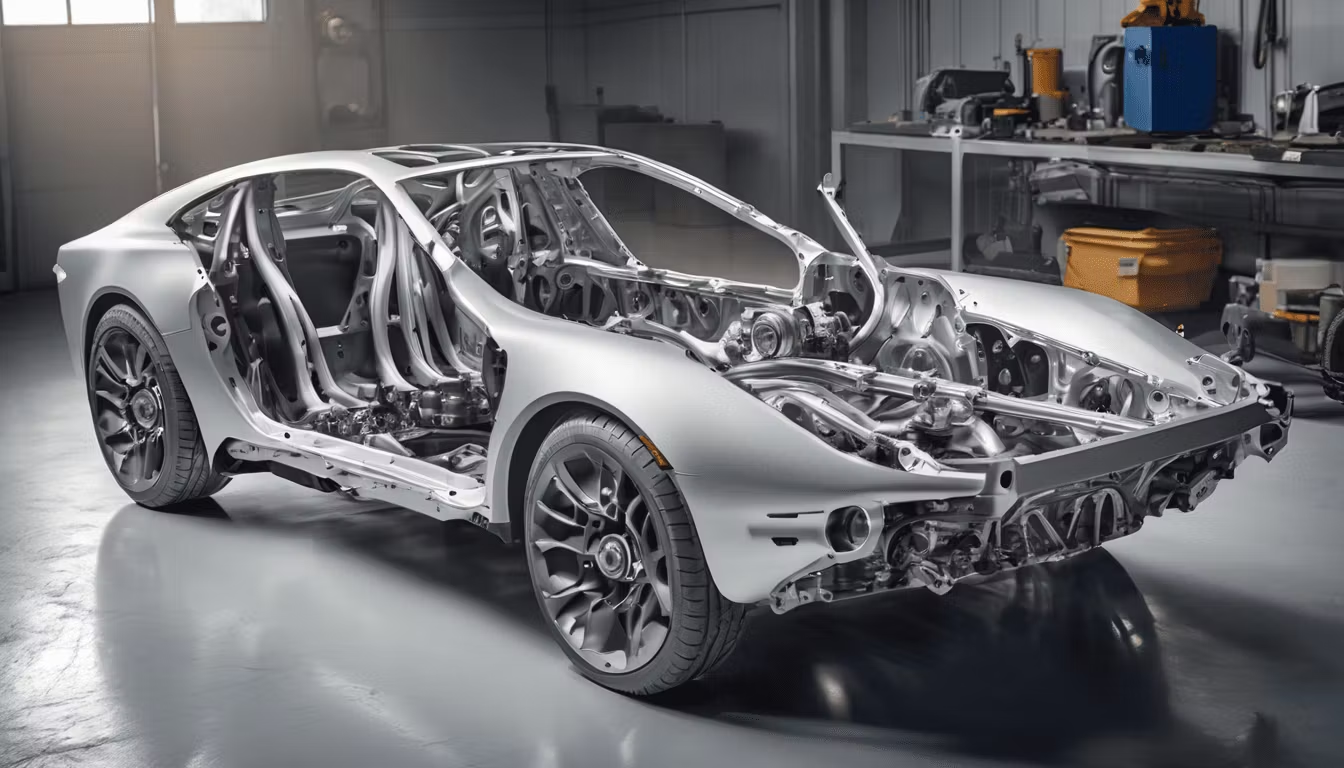
Weight reduction has become a central focus for automotive engineers worldwide. Every kilogram of weight saved translates directly into improved fuel efficiency, reduced emissions, and enhanced vehicle performance. Traditional steel components are being systematically replaced with die-cast aluminium parts throughout vehicle architectures—from engine blocks and transmission housings to suspension components and body panels.
A typical modern vehicle contains 100-150 kg of die-cast aluminium components, compared to just 50-70 kg in vehicles manufactured a decade ago. This trend accelerates as manufacturers target 20-30% weight reductions to meet increasingly stringent CO2 emission standards imposed by regulatory bodies globally. The shift toward lightweight construction directly correlates with heightened demand for premium-grade aluminium ingots suitable for high-pressure die casting applications.
2. Electric Vehicle (EV) Production Surge
The electric vehicle market represents the most significant growth driver for automotive die casting. EVs require substantially more aluminium than traditional internal combustion engine (ICE) vehicles for several reasons: battery enclosures, electric motor housings, power electronics mounting structures, and thermal management components all demand precision-cast aluminium parts with superior heat dissipation properties.
Global EV sales reached 13.6 million units in 2023, representing a 35% year-over-year increase. Industry analysts project that EVs will comprise 35-45% of global vehicle sales by 2030. This transformation implies that automotive die casting demand specifically for EV applications could triple over the next five years, creating unprecedented pressure on raw material suppliers to scale production capacity while maintaining quality standards.
3. Regulatory Pressure and Emissions Standards
Increasingly stringent environmental regulations across major markets—including the European Union's Euro 7 standard, China's National VI emission standard, and California's Advanced Clean Cars II regulations—mandate substantial reductions in vehicle tailpipe emissions. These regulations create economic incentives for manufacturers to invest in lightweight die-cast components that improve overall vehicle efficiency.
Compliance with these standards requires systematic vehicle redesign, presenting die casting manufacturers with multi-year contracts as OEMs implement new platforms incorporating significantly higher proportions of cast aluminium components.
4. Complexity in Modern Vehicle Designs
Contemporary vehicles incorporate advanced driver assistance systems (ADAS), integrated thermal management systems, and sophisticated electronic architectures that require precision-engineered die-cast housings and structural components. The complexity of these components makes die casting—with its ability to produce intricate geometries in single operations—the only economically viable manufacturing method.
Aluminium Demand in Automotive Applications
Specific Use Cases Driving Demand
The aluminium ingot market for automotive applications encompasses several critical use cases:
Engine Components: Cylinder heads, engine blocks, and intake manifolds represent high-volume die casting applications. These components demand aluminium with excellent thermal conductivity and strength-to-weight ratios, typically requiring ADC12 grade or equivalent specifications.
EV Battery Enclosures: As EV production accelerates, the need for precision-cast aluminium housings for battery packs has emerged as a major demand driver. These enclosures must provide superior electromagnetic shielding, thermal management, and structural rigidity while remaining lightweight.
Transmission and Drivetrain Components: Gear cases, torque converters, and transmission housings increasingly utilize die-cast aluminium to reduce weight and improve efficiency across both traditional and electric powertrains.
Structural and Chassis Components: Leading automotive manufacturers now incorporate die-cast aluminium in door handles, suspension brackets, steering components, and frame sections, representing growing volume opportunities for suppliers.
Quality Requirements and Specifications
Automotive die casting demands aluminium ingots meeting stringent quality specifications. Premium A7 grade and ADC12 grade ingots—characterized by controlled porosity, excellent fluidity, and minimal inclusion content—are industry standards. These specifications ensure consistent casting quality, mechanical properties, and dimensional accuracy across high-volume production runs.
Raw material quality directly impacts casting yield rates and component reliability. Premium-grade ingots reduce scrap rates by 2-5% compared to lower-grade materials, translating into significant cost advantages across high-volume production environments where millions of components are manufactured annually.
Market Challenges and Supply Chain Dynamics
Raw Material Volatility
Aluminium commodity prices remain subject to significant volatility driven by macroeconomic factors, energy costs, and geopolitical considerations. Automotive manufacturers increasingly seek long-term supply agreements with stable pricing mechanisms to mitigate exposure to price fluctuations that could impact profitability.
Capacity Constraints
Global demand growth for automotive-grade aluminium ingots has outpaced supply capacity expansion, creating supply-demand imbalances in key markets. Regional suppliers capable of consistently meeting automotive quality standards and volume requirements command premium pricing and enjoy strong customer retention.
Quality and Consistency
Die casting processes are highly sensitive to raw material variations. Aluminium ingots with inconsistent composition, temperature profiles, or microstructure characteristics directly translate into casting defects that compromise component integrity. This reality underscores the critical importance of sourcing materials from suppliers with robust quality management systems and third-party testing certifications.
Regional Manufacturing Hubs and Supply Chain Opportunities
Southeast Asia's Growing Importance
Southeast Asia, particularly Indonesia, has emerged as a strategic manufacturing location for automotive die casting. The region offers competitive labor costs, established supply chains, and increasingly sophisticated technical capabilities. Major automotive suppliers have established or expanded die casting facilities across the region to serve both domestic Southeast Asian vehicle markets and supply components to global OEMs.
Indonesia's strategic position as a source of high-quality raw materials, combined with improving manufacturing infrastructure, positions the country as an increasingly attractive location for die casting operations. Access to reliable, quality-assured raw materials is essential for die casting facilities to achieve competitive positioning in this dynamic market.
Future Outlook: What's Driving Next-Generation Demand
Advanced Manufacturing Technologies
Emerging manufacturing technologies including squeeze casting, vacuum-assisted die casting, and semi-solid metal processing are expanding the application envelope for die-cast aluminium. These advanced processes enable production of thinner wall sections, improved mechanical properties, and components previously requiring secondary machining operations.
Sustainability and Circular Economy Imperatives
Automotive manufacturers face intensifying pressure to implement circular economy principles, including increased recycled content in vehicle components and end-of-life recyclability design considerations. While recycled aluminium can be utilized in die casting, maintaining consistent quality requires careful management and blending with primary ingot materials to ensure specifications are maintained.
Autonomous Vehicle Development
Autonomous vehicle platforms require enhanced sensor integration, thermal management systems, and structural reinforcement for autonomous safety architectures, all driving incremental aluminium demand beyond traditional vehicle manufacturing.
Why Partner with Reliable Aluminium Suppliers
For die casting manufacturers and automotive suppliers seeking to capitalize on this market growth, sourcing decisions directly impact competitive positioning. Reliable suppliers must demonstrate:
- Consistent Quality: SUCOFINDO-tested materials with documented specifications and traceability
- Scalable Capacity: Ability to support volume growth from trial quantities through multi-million ton annual contracts
- Technical Support: Expertise in material selection, processing optimization, and troubleshooting
- Supply Chain Reliability: Dependable delivery schedules and inventory management to support just-in-time manufacturing operations
- Regulatory Compliance: Full licensing, certifications, and documentation supporting automotive industry requirements
Conclusion: Capitalizing on Automotive Die Casting Growth
The automotive die casting market is experiencing transformational growth driven by lightweight vehicle manufacturing, electric vehicle proliferation, and increasingly sophisticated automotive designs. This expansion directly translates into robust demand growth for premium-grade aluminium ingots, creating significant opportunities for suppliers positioned to meet automotive industry requirements.
CV Indoalam Mineral Persada stands ready to support automotive suppliers and die casting manufacturers throughout Southeast Asia. Our portfolio includes premium-grade aluminium ingot products specifically formulated for automotive die casting applications, backed by rigorous SUCOFINDO testing, full IUP OPK licensing, and the flexibility to support everything from trial quantities to multi-million ton annual supply agreements.
Whether you're optimizing existing die casting operations or scaling capacity to capture EV market growth, our experienced team understands automotive supply chain requirements and is committed to delivering the material quality and supply reliability your business demands. Contact us today to discuss how Indoalam can become your strategic partner in automotive material supply, or learn more about us and our commitment to quality and reliability in the mining and minerals trading industry.