Silica Sand Drying & Classification: Industrial Processing Guide
Introduction: Why Silica Sand Processing Matters
Silica sand is one of the most versatile industrial minerals, with applications spanning glass manufacturing, ceramics, foundries, water treatment, and construction materials. However, raw silica sand extracted from deposits contains moisture, dust, and particles of varying sizes that must be removed to meet industry specifications.
The two critical stages in silica sand processing are drying and classification. These operations directly impact product quality, cost efficiency, and customer satisfaction. For industrial buyers sourcing silica sand, understanding these processes ensures you receive material that meets exact specifications.
At CV Indoalam Mineral Persada, we employ advanced drying and classification systems to produce premium-grade silica sand with SiO2 content up to 99.74% and multiple mesh grades ranging from 8 to 200. This guide explores the industrial processing techniques that ensure consistency and quality.
Understanding Silica Sand Drying Methods
Rotary Dryer Technology for Sand Processing
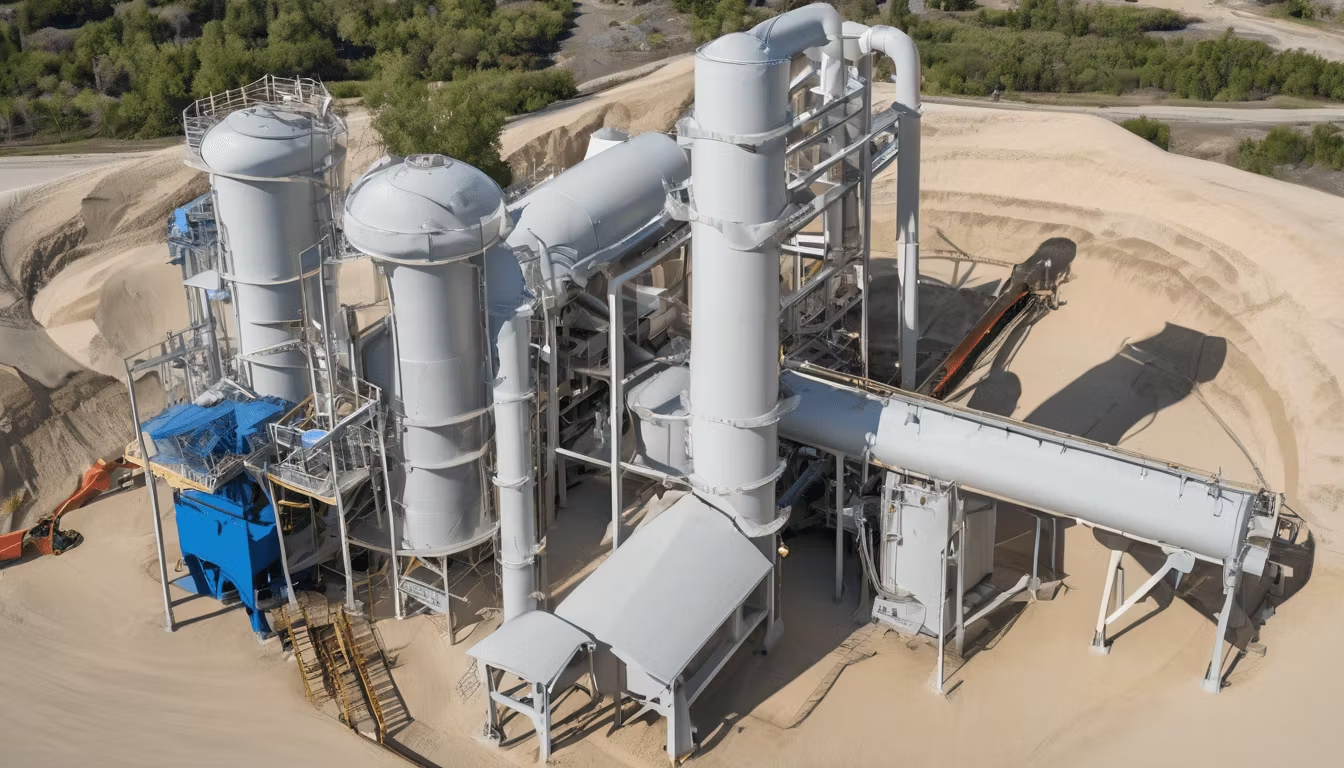
The rotary dryer is the backbone of modern silica sand drying operations. This equipment consists of a slightly inclined cylindrical drum that rotates continuously, allowing sand to tumble and cascade through hot air streams.
In rotary dryer sand processing, moisture content is reduced from typically 8-15% down to less than 2%, which is critical for downstream applications. The drum is heated externally, most commonly using natural gas or coal-fired burners, though some facilities employ indirect heating systems to minimize dust emissions.
Key advantages of rotary dryer systems include:
- High throughput capacity: Modern units can process 50-300 tons per hour depending on size and configuration
- Consistent moisture removal: Precisely controlled temperature and residence time ensure uniform drying
- Reduced energy consumption: Counter-current air flow maximizes heat transfer efficiency
- Minimal product degradation: Gentle tumbling action preserves particle integrity
The residence time in a rotary dryer typically ranges from 10-30 minutes, depending on feed moisture content and desired outlet moisture specifications. Operators must carefully monitor inlet and outlet temperatures—excessive heat can cause particle breakage and release unwanted fines.
Fluid Bed Dryers and Alternative Methods
While less common than rotary dryers for large-scale silica sand operations, fluid bed dryers offer advantages in specific scenarios. In this method, heated air is forced upward through sand, suspending particles in a fluidized state. This approach provides excellent heat transfer and uniform drying but consumes more energy than rotary systems.
Flash dryers and spray dryers are utilized in specialized applications where moisture content must be reduced extremely rapidly, typically for high-value silica sand products destined for electronics or pharmaceutical applications.
Silica Sand Classification Systems
Air Classifier Silica: Precision Particle Separation
Classification is the process of separating sand particles by size and density. Air classifier silica systems use differential air velocity to segregate material into distinct size fractions, removing fines (ultrafine particles) and oversized material simultaneously.
An air classifier operates on a straightforward principle: particles enter a vertical or inclined chamber where upward-moving air currents exert drag forces. Lighter, finer particles are carried upward with the air stream and separated as fines product, while heavier, coarser particles fall through the air stream and exit as classified sand product.
Benefits of air classification for silica sand include:
- Precise mesh grade control: Achieves tight particle size distributions (e.g., 100-150 mesh, 150-200 mesh)
- Fines removal: Eliminates particles below specified sizes, improving product quality
- No wet processing: Maintains dry conditions, avoiding slurry handling and additional drying cycles
- Operational flexibility: Easily adjustable air velocity allows multiple product grades from one feed source
For applications requiring multiple mesh grades, industrial operators typically employ multi-stage classification systems. This allows production of 8-16 mesh material for foundries, 100-120 mesh for glass manufacturers, and 150-200 mesh for ceramic tile producers—all from the same source material.
Mechanical Screening as a Complementary Process
While air classifiers excel at separating fine to medium particles, vibrating screens and rotating trommel screens remain essential for removing oversized material and protecting downstream equipment. Many modern facilities employ a screening stage before air classification to improve classifier efficiency and extend equipment lifespan.
Multi-deck screening systems can simultaneously separate material into 3-5 distinct size fractions, though this approach generates more dust and often requires subsequent air classification for fine-tuning product specifications.
Integrated Drying and Classification Workflow
Process Flow in Modern Facilities
A typical integrated silica sand processing circuit follows this sequence:
- Raw material reception and storage: Mined silica sand is stockpiled and fed into the primary circuit
- Primary screening: Oversize material (>10 mm) is removed to prevent dryer damage
- Rotary dryer stage: Moisture content reduced to 1-2% through controlled heating
- Cooler section: Dried sand is cooled with ambient air to prevent classification system degradation
- Air classification: Material is separated into product grades and fines streams
- Product storage: Classified sand is stored by grade for order fulfillment
This integrated approach ensures that only properly dried material enters the classifier, maximizing equipment performance and product consistency.
Quality Control Parameters During Processing
Throughout drying and classification, operators monitor critical parameters:
- Inlet moisture: Typically 8-15% for freshly mined material
- Outlet moisture: Target 0.5-2% depending on customer requirements
- Dryer temperature: Typically 180-220°C inlet, 80-100°C outlet
- Classification efficiency: Measured through sieve analysis of product and fines streams
- Silica content (SiO2): Regularly tested to confirm minimum purity specifications
- Particle size distribution: Verified against customer specifications using sieve analysis or laser diffraction
SUCOFINDO laboratory testing, as employed by CV Indoalam Mineral Persada, provides third-party verification of these parameters, offering customers confidence in product consistency.
Industry-Specific Applications and Specifications
Silica Sand for Glass Manufacturing
Glass manufacturers require silica sand with minimal iron oxide (<0.05% Fe₂O₃) and strict size specifications, typically 100-150 mesh. The material must be thoroughly dried—high moisture content can cause steam explosions during melting. Modern drying systems achieve the <1% moisture content necessary for float glass and specialty glass applications.
Foundry Applications
Foundries utilize coarser silica sand, typically 8-16 or 12-20 mesh, for core and mold production. These applications prioritize low clay content and high compression strength. Proper classification ensures accurate grain size distribution, directly affecting mold quality and casting surface finish.
Ceramic and Tile Production
Ceramic tile manufacturers blend silica sand with clay and other materials. They require precise mesh grades (often 150-200 mesh) and very low moisture to maintain proper moisture-clay ratios in production batches. Classification precision is paramount in this application.
Water Treatment Systems
Water treatment facilities employ silica sand in filtration beds. Specifications typically demand 12-20 mesh material with <2% moisture and effective size 0.5-0.7 mm. The uniform particle distribution achieved through air classification is essential for consistent filtration performance.
Challenges and Solutions in Silica Sand Processing
Moisture Rebound Issues
A common challenge occurs when dried silica sand reabsorbs moisture during storage or transport, particularly in high-humidity environments. Solutions include:
- Optimizing dryer outlet temperature to reduce hygroscopic moisture rebound
- Employing moisture barriers during bagging and transport
- Storing dried material in climate-controlled facilities
- Using specialized packaging that minimizes humidity exposure
Fines Generation and Control
Excessive fines (particles <100 mesh) reduce product value and can complicate downstream processes. Causes include:
- Over-heating in the dryer, causing particle breakage
- Excessive classifier air velocity, creating unnecessary fines
- Inefficient screening before drying, allowing delicate raw particles into the dryer
Prevention requires carefully tuned dryer parameters, properly sized classifiers, and robust primary screening stages.
Energy Efficiency Optimization
Drying is energy-intensive, typically consuming 50-100 kWh per ton of dried product. Energy recovery systems, such as heat exchangers capturing cooler exhaust air for preheating, can reduce consumption by 15-25%. Modern facilities increasingly employ variable frequency drives (VFDs) on dryer and classifier motors to optimize energy use during partial-capacity operations.
Choosing a Silica Sand Supplier with Advanced Processing
When sourcing silica sand, understanding a supplier's processing capabilities is crucial. Leading suppliers like CV Indoalam Mineral Persada invest in modern drying and classification infrastructure to deliver consistent, specification-compliant material.
Key questions to ask potential suppliers:
- What drying methods are employed, and what moisture levels are achievable?
- What classification systems are installed, and what mesh grades can be produced?
- Are products third-party tested (e.g., SUCOFINDO) to verify specifications?
- What quality consistency and traceability documentation is provided?
- Can the supplier accommodate varying order volumes and specifications?
CV Indoalam Mineral Persada maintains IUP OPK licensing and SUCOFINDO testing certification, ensuring that all silica sand products meet announced specifications. With annual capacity of 2.5 million metric tons and sourcing operations across Sulawesi, Kalimantan, and Maluku, we deliver flexible supply arrangements from 100 MT trial orders to annual contracts.
The Role of Silica Sand in the Broader Supply Chain
Silica sand is often one component in broader mineral supply strategies. Industrial operators managing multiple material streams benefit from integrated suppliers offering complementary products. CV Indoalam Mineral Persada supplies not only premium quartz sand but also zircon sand, aluminium ingots, and domestic nickel ore to major industrial parks and manufacturing facilities throughout Indonesia.
This integrated approach simplifies procurement, improves supply chain reliability, and often enables volume-based pricing benefits.
Conclusion: Investing in Processing Excellence
Silica sand drying and classification represent critical value-addition steps that transform raw mineral into specification-grade products ready for demanding industrial applications. Rotary dryer technology provides efficient, scalable moisture removal, while air classifier systems enable precise particle size control—both essential for meeting customer requirements across glass, ceramics, foundry, and water treatment sectors.
For procurement professionals and production managers, understanding these processes enables smarter supplier selection and procurement decisions. Partnering with suppliers who employ modern processing infrastructure, quality testing, and comprehensive licensing protects your operations and ensures consistent material supply.
Looking for reliable silica sand supply backed by advanced processing infrastructure and third-party testing? Contact CV Indoalam Mineral Persada to discuss your specifications, order volume requirements, and delivery preferences. Our IUP OPK-licensed operations, SUCOFINDO-verified products, and flexible supply arrangements make us the trusted choice for industrial buyers across Indonesia and international markets.