Resin Bonded Proppants: Manufacturing and Industrial Applications

Understanding Resin Bonded Proppants and Their Role in Industrial Applications
Resin bonded proppants represent a critical advancement in material science, combining high-quality silica sand with specialized polymer coatings to create materials that withstand extreme pressure and temperature conditions. In the energy sector, hydraulic fracturing operations depend on these engineered materials to maintain fracture conductivity and maximize well productivity. Beyond oil and gas, resin bonded proppants find applications in mining operations, water treatment systems, and industrial filtration processes.
The fundamental principle behind coated silica sand proppants is straightforward yet sophisticated: uniform sand particles are precision-coated with thermoplastic or thermoset resins that activate under specific downhole conditions. This coating provides multiple benefits, including enhanced crush resistance, improved proppant flowability, and superior pack permeability. For B2B buyers sourcing these materials, understanding the manufacturing process and quality specifications is essential for optimizing operational performance and cost efficiency.
The Manufacturing Process of Resin Bonded Proppants
Raw Material Selection and Quality Control
The journey to premium resin bonded proppants begins with raw material selection. Manufacturers require silica sand with consistent particle size distribution, high purity levels (typically >99% SiO₂), and minimal contaminants. The sand must demonstrate excellent roundness and smoothness to ensure uniform coating application and optimal packing characteristics.
At CV Indoalam Mineral Persada, we supply industrial-grade silica sand with SiO₂ content reaching 99.74%, meeting international specifications for proppant manufacturing. Our material sourcing from Sulawesi and Kalimantan regions, combined with SUCOFINDO laboratory testing, ensures consistency across batch sizes ranging from 100 metric tons for trials to 2.5 million metric tons annually.
Coating Technology and Application Methods
The coating process defines proppant performance characteristics. Modern manufacturing facilities employ several established sand coating technologies:
Fluidized Bed Coating: This method circulates sand particles in a controlled air stream while atomizing resin droplets. The continuous agitation ensures uniform coating thickness (typically 5-15 microns) without agglomeration. Temperature control is critical, maintaining conditions that allow resin particles to adhere without premature curing.
Continuous Tumble Coating: Rotating drums with internal lifters mix sand and resin binder, creating a gentle cascading action that distributes coating evenly. This approach works particularly well for larger batch sizes and enables precise control over coating weight and distribution patterns.
Spray Coating Systems: High-pressure spray application delivers resin suspensions onto moving sand beds, allowing operators to achieve specific coating thicknesses and densities. This technology provides excellent flexibility for custom formulations and small-batch specialty products.
Curing and Hardening Processes
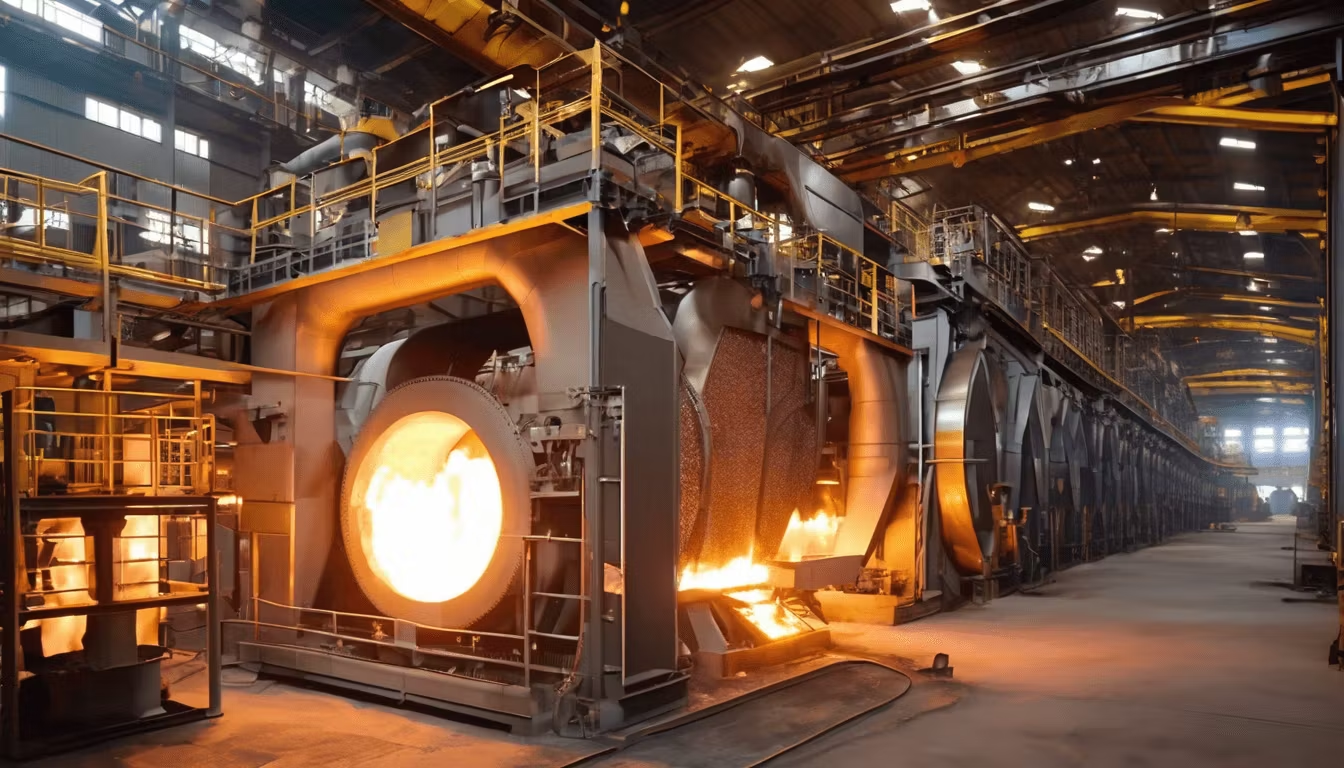
Following coating application, resin bonded proppants enter carefully controlled curing phases. For thermoplastic resins, this involves heating to activation temperatures (typically 200-300°F) to ensure polymer cross-linking and hardness development. Thermoset systems require longer curing periods at elevated temperatures to achieve full polymer network formation.
Quality manufacturers employ multiple hardness verification points throughout production, utilizing compression strength testing and crush resistance measurements to confirm that each batch meets published specifications. This rigorous quality assurance prevents field failures that can result in expensive well remediation.
Key Properties and Performance Specifications
Crush Resistance and Mechanical Strength
The primary performance metric for resin bonded proppants is crush resistance—the ability to maintain structural integrity under net stress conditions. High-quality coated silica sand proppants typically maintain >95% conductivity retention under closure stresses of 8,000-10,000 psi. This performance characteristic directly impacts well productivity and hydrocarbon recovery rates.
The resin bonding system provides this strength enhancement by creating an interconnected matrix that transfers loads across particle contacts. Unlike uncoated sand, which experiences particle rounding and migration under stress, resin-bonded materials maintain pack geometry and permeability throughout the well's productive life.
Conductivity and Flowability
Permeability—or conductivity—measures the ease with which fluids flow through the proppant pack. Resin bonded proppants engineered with proper coating thickness and particle size distribution maintain superior flowability compared to conventional materials. The uniform coating prevents fines generation that typically plugs pore networks in uncoated sand systems.
For industrial applications requiring quartz sand filtration, this characteristic translates to extended filter life and reduced maintenance cycles. Water treatment facilities, in particular, benefit from improved flow rates and reduced backwash frequency.
Temperature and Chemical Resistance
Modern resin bonding systems are formulated to withstand harsh downhole environments. Thermoplastic-coated proppants maintain integrity at temperatures up to 350°F, while advanced thermoset formulations can exceed 450°F. Chemical resistance properties prevent degradation from exposure to acids, bases, and hydrocarbon solvents encountered in subsurface formations.
Applications Across Multiple Industries
Oil and Gas Hydraulic Fracturing
Hydraulic fracturing remains the primary application driving resin bonded proppant demand globally. Operators deploying these materials in unconventional reservoirs—shale formations, tight sandstones, and low-permeability carbonates—achieve production improvements of 15-40% compared to conventional uncoated sand operations. The enhanced conductivity and crush resistance directly translate to increased wellbore productivity and extended asset life.
Mining and Geotechnical Applications
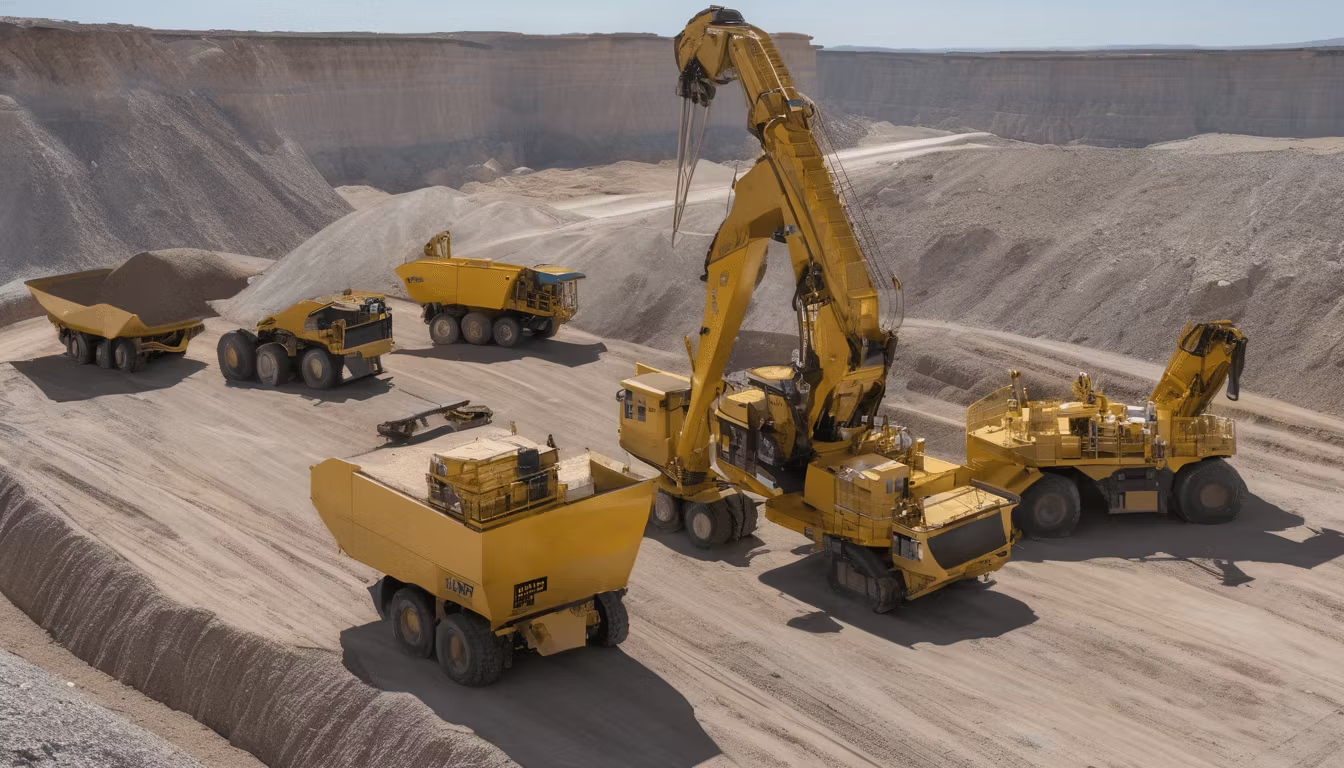
Mining operations employ coated silica sand proppants for wellbore stabilization, formation strengthening, and pressure maintenance in underground extraction systems. The durability characteristics that benefit oil and gas wells apply equally to mining geotechnical challenges, where extreme pressures and abrasive conditions demand superior material performance.
Industrial Filtration and Water Treatment
Water treatment facilities, ceramics manufacturers, and industrial processors utilize resin bonded materials for advanced filtration applications. The uniform particle coating prevents bridging and channeling that plagues conventional filter media, resulting in more consistent effluent quality and extended operational intervals between backwash cycles.
Construction and Composite Manufacturing
Specialized construction applications, particularly those requiring composite materials with engineered porosity and fluid transmission properties, benefit from precisely coated sand products. The controlled particle coating enables manufacturers to design materials with predetermined porosity distributions and drainage characteristics.
Sourcing Quality Materials for Proppant Manufacturing
Critical Quality Parameters for Input Materials
Proppant manufacturers establishing reliable supply chains must evaluate raw material suppliers across multiple dimensions. Silica purity (SiO₂ content ≥99.5%) ensures minimal impurities that could interfere with resin bonding or proppant performance. Particle size distribution analysis confirms uniformity, while roundness and sphericity measurements validate that source materials will accept coatings evenly.
Additionally, moisture content, bulk density, and trace element composition (particularly iron oxide levels) significantly impact coating adhesion and final product performance. Reputable suppliers like CV Indoalam Mineral Persada provide certified laboratory testing through recognized third-party agencies like SUCOFINDO, guaranteeing consistency across multiple shipments and production cycles.
Supply Chain Reliability and Scalability
Proppant manufacturers require suppliers capable of fulfilling orders ranging from small trial quantities to multi-year supply agreements. CV Indoalam's operational capacity of 2.5 million metric tons annually, combined with established IUP OPK licensing and RKAB approval, positions us as a reliable partner for manufacturers scaling operations. Our direct mining relationships across Indonesia—sourcing from Sulawesi, Kalimantan, and Maluku—ensure supply security and competitive pricing for long-term contracts.
Whether your operation requires 100 metric tons for quality assessment or sustained monthly deliveries supporting multi-plant manufacturing operations, our flexible supply model accommodates diverse customer requirements without compromising material consistency.
Technical Considerations for Buyers
Specification Development and Testing Protocols
Establishing detailed material specifications prevents quality inconsistencies that cascade through manufacturing processes. Comprehensive specifications should address:
- Particle size distribution (mesh grades 8-200 commonly specified for proppant applications)
- Silica content and impurity thresholds
- Moisture content limitations
- Bulk density parameters
- Particulate contamination limits
- Chemical composition analysis (iron oxide, alumina, magnesia)
Regular testing protocols validate that incoming materials maintain specification compliance throughout supply agreements. Many manufacturers implement receiving inspection procedures that screen 1-5% of delivered lots, providing statistical confidence in overall shipment quality.
Cost Optimization and Volume Economics
Raw material costs represent 35-50% of resin bonded proppant production expenses, making supplier selection critical for competitive pricing. Direct sourcing from mine operators eliminates distributor margins, and bulk volume contracts typically offer 10-25% pricing advantages over smaller purchase orders.
However, cost optimization should not compromise quality specifications. Material variations that seem insignificant—slightly elevated iron oxide or inconsistent particle roundness—can degrade coating performance and reduce proppant crush resistance by 5-15%, ultimately undermining product competitiveness and customer satisfaction.
Industry Trends and Future Considerations
Advancing Coating Technologies
The industry continues evolving toward environmentally compatible resin systems and enhanced performance formulations. Bio-based polymers, advanced thermoset chemistries, and nano-particle coating enhancements represent emerging technologies that demand raw materials meeting increasingly stringent quality parameters. Proppant manufacturers investing in R&D require suppliers capable of providing materials for experimental formulations while maintaining commercial supply for established product lines.
Regional Market Dynamics
Global proppant demand continues accelerating in Asia-Pacific markets, particularly as Southeast Asian oil and gas operators expand unconventional resource development. Indonesian suppliers like CV Indoalam possess geographic advantages for supporting regional manufacturing expansion, offering shorter logistics timelines and reduced transportation costs compared to importing materials from North American or Middle Eastern sources.
Conclusion: Partnering with Reliable Material Suppliers
Resin bonded proppant manufacturing success depends fundamentally on consistent, high-quality raw materials. The coating technologies and curing processes that transform silica sand into premium proppants can only deliver superior performance when starting with materials that meet rigorous specifications across multiple quality dimensions.
CV Indoalam Mineral Persada provides silica sand specifically suited for coated proppant manufacturing, with documented purity exceeding 99.74% SiO₂ and laboratory certification through SUCOFINDO testing protocols. Our licensed operations, established relationships with major regional industrial customers, and flexible supply model support proppant manufacturers ranging from specialty product developers to high-volume commercial operations.
Whether you're establishing a new proppant manufacturing facility, scaling existing operations, or seeking alternative supply sources, we invite you to contact us to discuss material specifications, volume requirements, and delivery arrangements. Our technical team can provide detailed quality documentation, arrange material sampling, and develop customized supply agreements aligned with your manufacturing operations.
For comprehensive information about our product portfolio, certifications, and sourcing capabilities, visit about us or explore our complete material specifications and pricing for immediate inquiry processing.