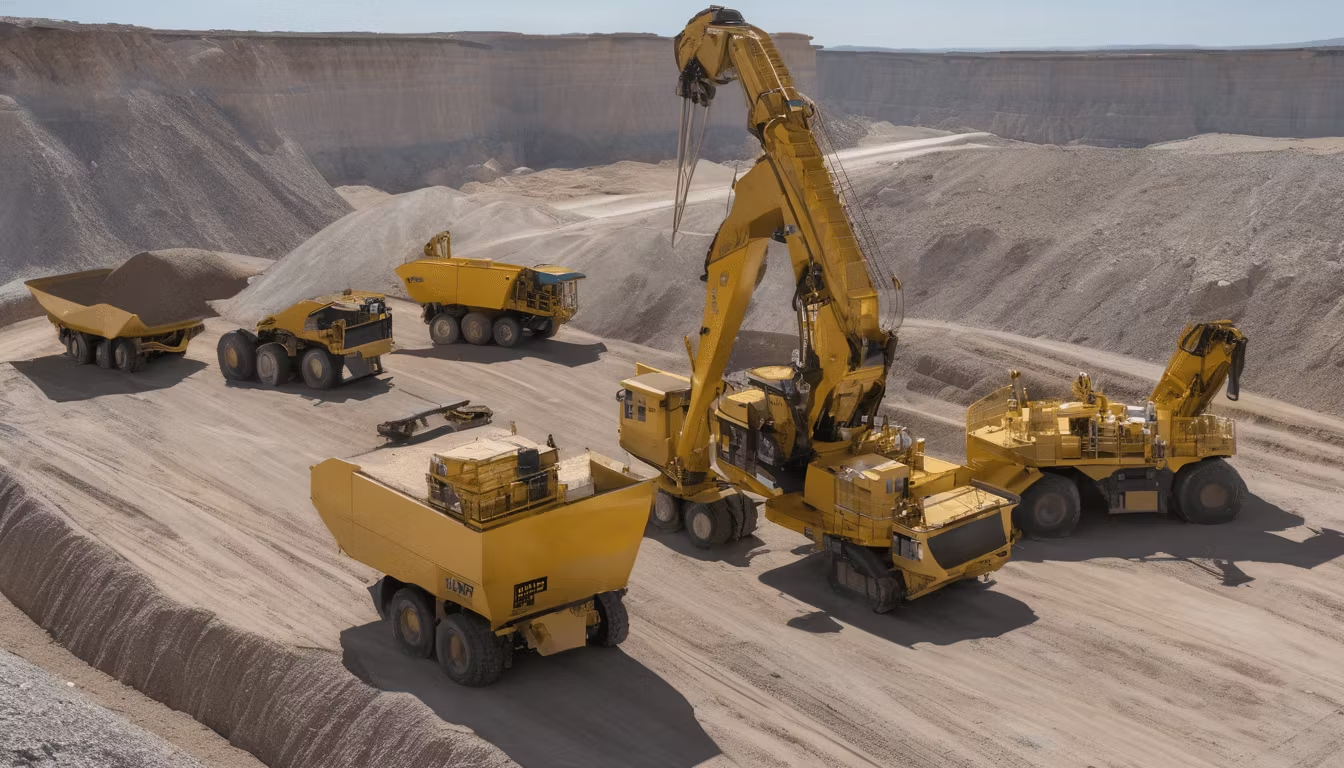
Commodity Price Risk Management: Hedging Strategies for Mineral Buyers

Commodity Price Risk Management: Hedging Strategies for Mineral Buyers
Mineral procurement represents one of the largest variable cost categories for manufacturers in the glass, ceramics, foundry, and construction industries. Volatile commodity markets—particularly for nickel ore, silica sand, and other industrial minerals—create significant budgeting challenges for B2B buyers. A single price spike can erode profit margins, while sudden drops create opportunity costs. This reality makes commodity price risk management not just advisable, but essential for operational stability.
For production managers and procurement teams, understanding hedging strategies and price management techniques can mean the difference between predictable costs and budget surprises. This guide explores practical approaches to managing mineral price volatility and protecting your supply chain investments.
Understanding Commodity Price Volatility in the Mining Sector
What Drives Mineral Price Fluctuations?
Mineral commodity prices are influenced by interconnected global factors that procurement teams must monitor continuously:
- Supply-side pressures: Mining disruptions, export restrictions, transportation bottlenecks, and regulatory changes affect available inventory. For example, nickel ore pricing responds directly to production capacity at major smelting facilities.
- Demand cycles: Construction booms, automotive manufacturing expansion, and infrastructure projects drive consumption patterns. Solar panel manufacturers, for instance, increase silica sand demand during growth phases.
- Currency fluctuations: Since most industrial minerals trade in USD, currency strength in producing nations like Indonesia significantly impacts import costs.
- Geopolitical factors: Trade tensions, sanctions, and regional conflicts disrupt supply chains and create price uncertainty.
- Speculation and financial flows: Commodity futures trading and investment fund positioning amplify price movements beyond physical supply-demand fundamentals.
Understanding these drivers helps procurement teams anticipate volatility and position hedging strategies accordingly.
The Cost of Unmanaged Price Risk
Without active price risk management, mineral buyers face significant exposure:
- Budget overruns when commodity prices spike unexpectedly
- Margin compression on fixed-price customer contracts
- Inventory devaluation if prices fall after purchase
- Competitive disadvantage against hedged competitors
- Working capital strain from price volatility
Effective hedging transforms unpredictable costs into manageable, forecasted expenses.
Core Commodity Hedging Strategies for Mineral Procurement
1. Futures Contracts and Commodity Derivatives
Futures contracts represent standardized agreements to buy or sell a specific commodity at a predetermined price on a future date. For minerals like nickel and aluminium, futures markets provide liquidity and price discovery mechanisms.
How it works: If you anticipate purchasing 500 metric tons of aluminium ingot in three months at current prices, you can lock in the futures price today. If market prices rise, your futures position gains value, offsetting higher physical purchase costs. If prices fall, futures losses are balanced against cheaper physical purchases.
Advantages:
- Price certainty for budget planning
- Highly liquid markets (especially for major commodities)
- Standardized contracts reduce counterparty risk
- Lower transaction costs compared to over-the-counter alternatives
Disadvantages:
- Basis risk (futures and physical prices don't move identically)
- Margin requirements and daily settlement obligations
- Complexity in accounting and reporting
- Limited availability for specialized minerals (especially domestically-focused commodities)
2. Forward Contracts and Direct Supplier Agreements
Forward contracts are customized agreements directly with suppliers to deliver specific quantities at agreed prices on future dates. For companies sourcing from established mining suppliers, this approach offers practical advantages.
How it works: Rather than purchasing commodity spot prices, you negotiate a fixed price with your supplier for deliveries over a 6-12 month period. This price might include a modest premium for the supplier's certainty, but you gain cost predictability.
Companies like CV Indoalam Mineral Persada, as direct mining suppliers, can negotiate flexible forward agreements for silica sand and other minerals, allowing buyers to lock in prices for trial quantities (as low as 100 MT) through multi-million-ton annual contracts.
Advantages:
- Customized terms matching your specific needs
- Stronger supplier relationships and communication
- Simpler accounting treatment
- No margin calls or derivative accounting complexity
- Flexibility for specialty minerals without exchange trading
Disadvantages:
- Counterparty credit risk (supplier default)
- Less liquidity if you need to exit positions
- Requires strong supplier relationships and trust
- Limited transparency compared to exchange-traded prices
3. Options Strategies (Calls and Puts)
Options provide the right—but not obligation—to buy (call) or sell (put) commodities at predetermined prices. This flexibility suits buyers who want price protection without the commitment of futures or forwards.
Buy a put option: Locks in a maximum purchase price while allowing you to benefit if prices fall below the strike price. You pay a premium upfront for this insurance.
Buy a call option: Protects against price increases while preserving downside flexibility. Useful when you might reduce consumption or switch suppliers if prices fall.
Advantages:
- Asymmetric payoff (limited downside, unlimited upside potential)
- Flexibility to walk away if market conditions change
- Useful for uncertain demand scenarios
Disadvantages:
- Expensive premium costs
- Complexity in valuation and accounting
- Limited availability for specialty minerals
- Time decay erodes option value if price doesn't move
4. Collar Strategies
A collar combines buying protective puts and selling call options, creating a price band. You're protected against prices rising above a ceiling, while accepting a price floor in exchange for reduced premium costs.
How it works: You buy a put at $500/MT and sell a call at $550/MT. Whether prices move to $450 or $600, your effective cost stays between $500-$550/MT. The premium from selling the call offsets the cost of buying the put.
This strategy suits buyers with stable, predictable consumption patterns who want reasonable protection without the full cost of pure hedges.
Practical Implementation Framework for Mineral Buyers
Step 1: Assess Your Exposure Profile
Before implementing hedging, quantify your commodity price exposure:
- Consumption forecast: How much zircon sand, silica sand, or other minerals will you purchase over 12 months?
- Budget impact: What price movement would significantly impact profitability?
- Margin structure: Can you pass through price increases to customers, or are you locked into fixed-price contracts?
- Working capital capacity: Can you handle margin calls on futures positions?
- Operational flexibility: Can you adjust production volumes if prices spike?
Step 2: Determine Your Hedging Ratio
You don't need to hedge 100% of consumption. Consider hedging strategies:
- Conservative (80-100%): Lock in most consumption at predictable prices. Suitable for fixed-margin businesses.
- Moderate (50-70%): Balance cost certainty with profit upside if prices decline. Typical for most manufacturers.
- Minimal (0-30%): Accept price volatility but maintain flexibility. Appropriate for commodity traders or businesses with pricing power.
Step 3: Select Appropriate Instruments
Match hedging tools to your circumstances:
- Commodity futures: Best for large-volume, price-sensitive commodities (aluminium, nickel). Requires commodity trading account and derivatives expertise.
- Forward contracts: Ideal for specialty minerals or direct sourcing relationships. Works well with established suppliers offering flexible terms.
- Options: Choose when demand is uncertain or you want asymmetric protection.
- Supplier agreements: Combine physical supply security with price stability through long-term partnerships.
Step 4: Execute and Monitor
Once positions are established:
- Track basis (difference between futures and physical prices)
- Monitor counterparty credit if using forwards
- Rebalance positions quarterly based on consumption changes
- Document hedges for accounting and tax purposes
- Review strategy effectiveness annually
Industry-Specific Hedging Considerations
For Glass and Ceramic Manufacturers
Your primary commodity exposure is high-purity silica sand. Options include:
- Futures contracts for bulk volume (if available in your market)
- Long-term supply agreements with reliable producers locking price escalation clauses
- Dual-supplier strategy where one supplier provides spot flexibility and another provides forward certainty
For Metal Foundries and Casters
Multiple commodity exposures (aluminium, zircon, silica) suggest:
- Separate hedges for each material based on consumption volumes
- Portfolio-level optimization considering correlations between commodities
- Close coordination with sales teams on fixed-price customer contracts
For Nickel Smelters
Direct nickel ore purchasing from Indonesia involves unique considerations. Since domestic nickel ore exports are restricted, buyers source exclusively from domestic suppliers. In this context:
- Price hedging focuses on maintaining supplier relationships and negotiating favorable contract terms
- Long-term supply agreements with mining companies provide cost predictability
- Volume commitments (e.g., 100 MT trials scaling to 2.5M MT/year contracts) reduce per-unit costs and ensure supply security
Common Hedging Mistakes to Avoid
1. Over-Hedging
Hedging more than your actual consumption creates speculative positions. If you plan to purchase 1,000 MT of material but hedge 1,500 MT, you're betting on price movements rather than managing genuine business risk.
2. Ignoring Basis Risk
Futures prices don't perfectly track physical commodity prices. Quality grades, location premiums, and timing mismatches create basis risk. A hedge that's 95% effective still leaves 5% exposure.
3. Neglecting Cash Flow Impact
Futures positions require daily margin settlements. Unexpected margin calls can strain working capital. Model cash flow scenarios before committing to large hedge positions.
4. Failing to Align Accounting
Unrealized gains/losses on derivative positions affect financial statements. Without proper hedge accounting treatment, volatility in earnings can mislead investors and creditors.
5. Static Hedging Strategies
Market conditions change. Annual reviews of hedging strategies ensure your approach remains appropriate as your business evolves, supply chain dynamics shift, and new market instruments become available.
The Role of Reliable Suppliers in Price Risk Management
Effective commodity hedging requires more than financial instruments—it demands reliable supply partnerships. Suppliers offering transparency, consistent quality, and flexible contracting options become critical risk management tools themselves.
Working with direct mining suppliers who offer:
- SUCOFINDO lab-tested quality assurance
- Flexible purchase terms (trial quantities to large volume contracts)
- IUP OPK licensing and regulatory compliance
- Multi-year supply stability
...significantly reduces supply chain risk and strengthens your ability to implement predictable hedging strategies. Rather than managing price volatility alone, you benefit from supplier relationships that provide both cost certainty and quality consistency.
Building Your Commodity Risk Management Program
Implementing comprehensive commodity hedging requires:
- Cross-functional team: Procurement, finance, operations, and sales must align on risk tolerance and hedging objectives.
- Clear policies: Document which commodities are hedged, at what ratios, and using which instruments.
- Systems and expertise: Invest in market data terminals, analytics tools, and staff training or external advisors.
- Regular monitoring: Quarterly reviews of hedge effectiveness and market conditions.
- Flexibility: As market conditions evolve, adjust strategies to remain relevant and effective.
Conclusion: Transform Price Volatility Into Managed Risk
Commodity price volatility is an inherent reality of mineral-dependent industries. Rather than accepting this uncertainty passively, sophisticated procurement teams implement hedging strategies that convert unpredictable price swings into manageable, forecasted costs.
Whether you choose commodity futures for large-volume standard minerals, forward contracts with trusted suppliers for specialty materials, or options-based strategies for uncertain demand, the key is systematic approach: assess exposure, determine hedging objectives, select appropriate instruments, and monitor continuously.
For procurement teams sourcing minerals like silica sand, aluminium ingot, or zircon sand, the most practical hedging often combines financial instruments with long-term supply agreements. Establishing partnerships with reliable, fully-licensed suppliers offers both price stability and supply security—foundational elements of effective risk management.
If you're looking to implement more stable mineral procurement with flexible supply agreements and transparent pricing, contact us to discuss how direct supplier relationships can complement your hedging strategy and strengthen your supply chain resilience.