Aluminium Die Casting Defects: How Raw Material Quality Matters

Introduction: The Hidden Cost of Poor Aluminium Quality in Die Casting
Die casting defects represent one of the most costly challenges facing foundries and metal casters worldwide. While many manufacturers focus on optimizing casting processes and equipment, they often overlook a critical factor: the quality of their raw aluminium ingot materials.
In the die casting industry, defects such as porosity, shrinkage cavities, cold shuts, and surface imperfections can reduce product yield, increase scrap rates, and damage customer relationships. Yet these defects frequently stem not from process failures, but from compromised feedstock quality.
This comprehensive guide explores the direct relationship between aluminium raw material quality and die casting performance, with specific focus on ADC12 grade specifications and practical solutions for foundries seeking to minimize defects and maximize production efficiency.
Understanding Die Casting Defects: Root Causes and Industry Impact
Common Die Casting Defects Explained
Die casting defects manifest in various forms, each with distinct causes and consequences:
Casting Porosity represents the most prevalent defect category, characterized by gas cavities trapped within the metal matrix. These microscopic or visible voids significantly weaken mechanical properties, reducing tensile strength and elongation values. Porosity becomes especially problematic in applications requiring high fatigue resistance, such as automotive engine components or industrial machinery housings.
Shrinkage cavities occur when molten metal contracts during solidification, leaving void spaces that weaken structural integrity. Unlike gas porosity, shrinkage defects develop predictably at thick sections or junctions where cooling rates vary dramatically.
Cold shuts happen when two metal streams meet during mold filling but fail to fuse properly, creating weak boundaries. Surface roughness, inclusions, and micro-segregation also plague production runs, affecting aesthetics and functional performance.
The True Cost of Die Casting Defects
Industry data reveals that defect-related scrap and rework costs typically consume 3-8% of total foundry operating budgets. For high-volume operations processing millions of components annually, this translates to hundreds of thousands of dollars in waste. Beyond direct financial losses, defects trigger customer complaints, warranty claims, and potential safety liabilities in critical applications.
Most importantly, defects erode competitive advantage by increasing production timelines and reducing equipment throughput. Foundries with consistently high-quality output capture market share and command premium pricing.
How Raw Material Quality Directly Impacts Die Casting Performance
Aluminium Ingot Composition and Its Effects
ADC12 aluminium alloy represents the industry standard for die casting applications, offering excellent fluidity, mechanical properties, and cost efficiency. However, not all ADC12 ingots perform identically. The composition, impurity levels, and metallurgical structure of source material profoundly influence downstream casting quality.
Premium grade ADC12 aluminium ingot maintains strict control over:
- Silicon content (9.6-12.4%) – Provides fluidity and reduces shrinkage tendency, but excessive levels increase brittleness
- Copper content (1.5-3.5%) – Enhances strength but promotes segregation if uncontrolled
- Iron content (maximum 1.3%) – Forms hard phases that reduce ductility; lower is better
- Zinc, magnesium, and trace elements – Must remain within narrow ranges to maintain consistent casting behavior
- Hydrogen porosity potential – High hydrogen content in ingots directly correlates with gas porosity defects in finished castings
Impurity Control and Hydrogen Management
Hydrogen gas dissolves readily in molten aluminium but becomes trapped during solidification, creating characteristic rounded gas cavities. Foundries with inconsistent material sources experience unpredictable hydrogen levels, making defect prevention impossible despite optimized casting parameters.
Superior aluminium ingot suppliers employ advanced degassing techniques, grain refinement practices, and rigorous testing protocols to minimize hydrogen content before material reaches foundries. This upstream quality management dramatically reduces downstream porosity defects.
Metallurgical inclusions—oxides, carbides, and other non-metallic phases—create stress concentration points where cracks initiate. Premium ingots undergo cleanliness filtering and refinement processes that remove these harmful particles.
Grain Structure and Mechanical Properties
The crystalline grain structure established during ingot solidification influences mechanical behavior throughout subsequent processing. Fine, uniform grain structures produced through controlled cooling and grain refinement deliver superior strength, ductility, and fatigue resistance compared to coarse or segregated structures.
Foundries using inconsistently structured ingots experience variable casting properties, making it impossible to achieve reliable mechanical specifications across production batches.
ADC12 Quality Standards: What Premium Suppliers Deliver
Laboratory Testing and Certification
Leading material suppliers like CV Indoalam implement comprehensive testing protocols using facilities such as SUCOFINDO certification, ensuring every ingot batch meets or exceeds ADC12 specifications. This includes:
- Chemical composition analysis via spectroscopy
- Hydrogen content measurement (reduced-pressure testing)
- Mechanical property verification (tensile strength, elongation, hardness)
- Microstructural examination and grain size assessment
- Cleanliness rating and inclusion analysis
- Density and porosity evaluation
Third-party lab certification provides objective verification that purchased material meets contractual specifications, eliminating disputes and ensuring foundry confidence.
Traceability and Consistency
Premium suppliers maintain detailed production records for every ingot batch, documenting source origin, processing parameters, testing results, and certification data. This traceability allows foundries to correlate specific material batches with casting performance outcomes, enabling continuous improvement and root cause analysis when defects occur.
Consistent, traceable material sourcing represents a significant competitive advantage for foundries seeking to achieve Six Sigma quality levels.
Practical Strategies for Foundries to Minimize Die Casting Defects
Material Selection and Supplier Partnerships
Foundries should establish long-term partnerships with qualified aluminium ingot suppliers capable of demonstrating:
- Certified laboratory testing protocols and published test reports
- Consistent batch-to-batch composition and hydrogen levels
- Licensed production facilities with quality management systems
- Proven supply chain stability and reliability
- Technical support for process optimization
Initial material qualification trials should include pilot casting runs with comparative defect analysis against baseline materials. This investment in qualification prevents costly problems after full production commitment.
Process Parameter Optimization
Even premium material cannot overcome severe process deficiencies. Foundries must simultaneously optimize:
- Metal temperature management – Proper superheat prevents cold shuts and improves fluidity
- Mold temperature control – Consistent cooling rates reduce segregation and shrinkage porosity
- Gating system design – Smooth metal flow reduces turbulence and gas entrapment
- Injection velocity and pressure profiles – Balanced parameters minimize porosity while preventing defects
- Degassing procedures – In-house hydrogen removal extends the advantage of quality feedstock
Quality Monitoring and Continuous Improvement
Implement statistical process control tracking casting defect rates, mechanical properties, and dimensional consistency. Correlate defect patterns with material batch data to identify trends. Regular process audits and equipment maintenance prevent capability drift.
Advanced foundries employ X-ray computed tomography (XCT) scanning to quantify internal porosity, enabling data-driven decisions about material purchases and process adjustments.
Why Direct-from-Mine Suppliers Make a Difference
Supply chain complexity introduces variability. Material passing through multiple middlemen may undergo remelting, oxidation, or contamination risk, degrading quality. Suppliers sourcing directly from certified production facilities—with IUP OPK licensing, RKAB approval, and SUCOFINDO verification—eliminate these intermediary risks.
Direct sourcing also enables foundries to establish technical relationships with material producers, facilitating custom processing, batch segregation, and rapid troubleshooting when issues arise.
Looking Beyond Aluminium: Complementary Materials for Comprehensive Casting Solutions
While aluminium represents the primary casting alloy, foundries often require complementary materials for mold production, refractories, and secondary processing:
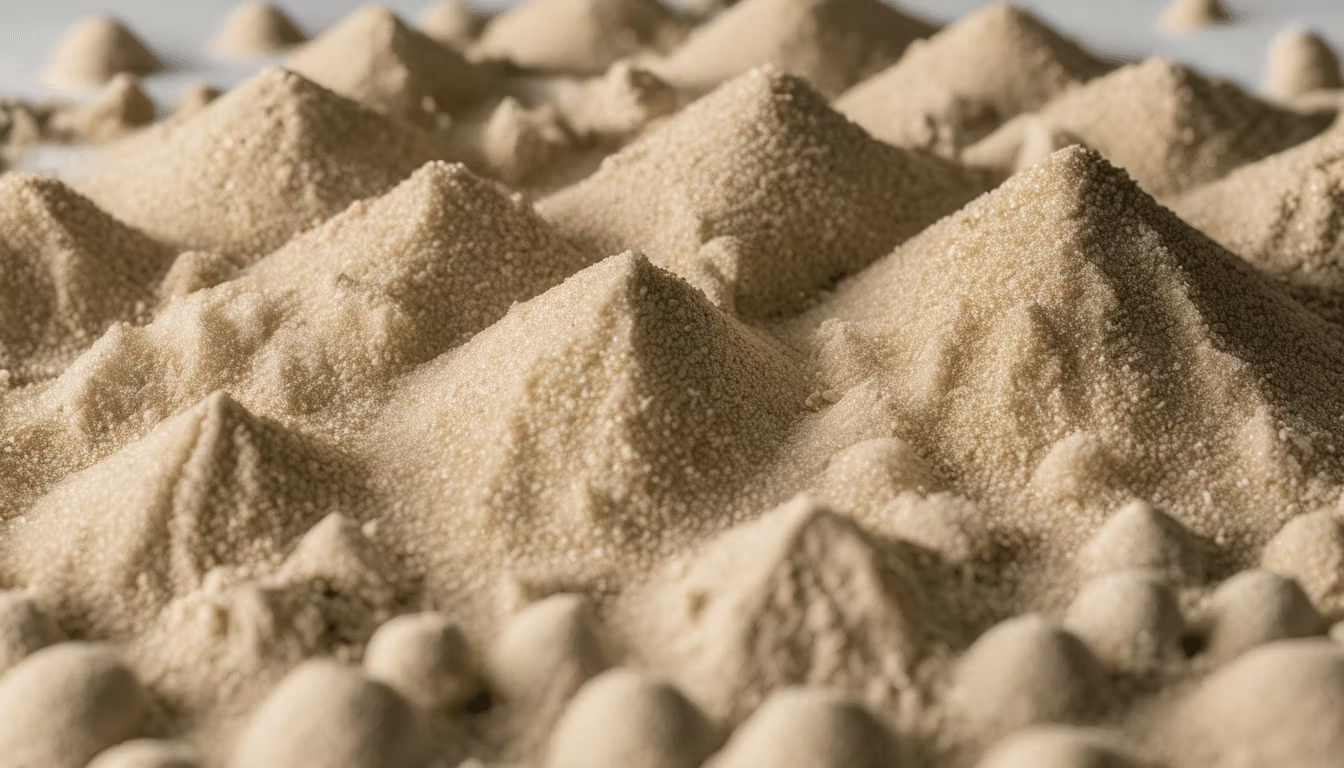
Silica sand and quartz sand serve as foundational mold materials, directly influencing casting surface quality and dimensional accuracy. High-purity silica sand (SiO2 99.74%+) with controlled grain size distributions ensures consistent mold properties. Zircon sand additives provide superior refractory properties in critical mold sections, particularly for high-temperature applications.
Integrated suppliers offering complete material packages—from aluminium ingot feedstock to zircon sand refractory materials—streamline procurement, improve consistency across production inputs, and simplify quality accountability.
Choosing Your Aluminium Supplier: Key Evaluation Criteria
When evaluating potential aluminium ingot suppliers, prioritize:
- Certifications and testing – Verify SUCOFINDO certification, ISO 9001 compliance, and independent lab access
- Regulatory compliance – Confirm IUP OPK licensing, RKAB approval, and environmental compliance
- Supply capacity and flexibility – Ensure ability to support both trial quantities and full-scale production commitments
- Technical expertise – Request process improvement consultation and defect troubleshooting support
- Geographic proximity and logistics – Evaluate shipping costs, lead times, and supply chain reliability
- Reference customers – Contact existing foundry clients to verify real-world performance and reliability
Conclusion: Quality Feedstock as Strategic Competitive Advantage
Die casting defects represent multifaceted challenges requiring integrated solutions across material selection, process optimization, and quality management. However, the foundation begins with premium raw materials from trusted suppliers.
By partnering with suppliers committed to rigorous quality control, comprehensive testing, and consistent material properties, foundries can dramatically reduce defect rates, improve mechanical properties, and enhance customer satisfaction. The investment in premium aluminium ingot materials typically yields rapid ROI through scrap reduction and improved throughput.
CV Indoalam Mineral Persada has established itself as a trusted supplier of premium-grade aluminium ingot (ADC12, A7) to foundries and metal casters across Indonesia and international markets. Backed by SUCOFINDO laboratory certification, IUP OPK licensing, and RKAB approval, Indoalam delivers consistent, traceable material meeting the stringent requirements of modern die casting operations.
Whether you're managing defect challenges or seeking to upgrade your material supply chain, contact us to discuss how premium aluminium ingots can transform your casting quality and operational efficiency. Request trial samples, review certification documentation, and explore customized supply partnerships designed for your specific production requirements.